
Property Management Services

From skyscrapers to manufacturing plants, across all types of industries, and in companies both large and small, facility asset management is the quiet but vital linchpin responsible for optimizing operations, maximizing asset lifecycles, and contributing to a company’s bottom line.

Facility asset management is a broad service that encompasses multiple obvious and not-so-obvious aspects of a business’ day-to-day functions. When operations are running seamlessly it’s easy to forget about facility asset management, especially when it’s handled by a third party. But when things go wrong, the important role of the facility asset manager—and how it affects business efficiency—becomes apparent. This is why it’s so important to pick the right facility asset management service for your company.

Facility Asset Management—What’s Involved?

So, what are facility assets? The precise answer can vary, depending on the organization, but facility assets are generally thought of as those that affect the day-to-day operations of the business and support occupants’ needs inside buildings and on the grounds outside of the facility.

In a Berkshire Hathaway survey of companies across multiple sectors, 70% reported losing productivity due to unexpected asset repairs and replacements.

Traditionally, these assets have been considered the tangible and physical items in a facility. However, with the expansion of technology, intangible assets such as CMMS (computerized maintenance management systems) and HVAC fault detection and diagnostics may also fall under the purview of facility asset management.

Some experts have defined facility assets as anything that needs to be maintained at least once a year or is valued at more than $5,000. While these may be good additional guidelines, relying on a dollar amount or a maintenance standard may miss some critical assets—or conversely, include less relevant ones, depending on your facility.

The official definition of a facility asset comes from ISO 55000, set by the International Organization for Standardization. This standard defines an asset as “an item, thing or entity that has potential or actual value to an organization.” Asset management is defined as a discipline that helps to “better achieve organizational objectives while realizing greater value from their assets.”

In other words, assets are items with actual or potential value to the facility that would cause disruption to operations or business objectives when not functioning. Since ISO recommendations are considered the gold standard for best practices in areas such as quality control and safety, this definition of asset management is a good reference point, so if in doubt, referring to ISO 55000 is a good bet.

Strategies, Methods, and Best Practices

Expert facility asset management is crucial to maximizing the longevity and productivity of your capital assets. To achieve this outcome, a facility’s asset management program should include the following:

Comprehensive Asset Inventory

The first step in effectively managing your assets is to have comprehensive information on each one. That means every asset is tagged and barcoded, and its identifying information is entered into a tracking system that’s accessible by all those who need it. Having up-to-date and organized records of all facility assets promotes informed decision-making. While the labor and time involved in reconciling incomplete or inaccurate data may seem daunting, the effort will be rewarded with less disruption in the long term and greater insights into your facilities’ operations.

Lifecycle Planning and Management

Lifecycle planning is a core part of facilities asset management. Being able to identify when assets are nearing the end of their life and developing strategies around asset lifecycles can provide significant cost savings for your organization.

A technician in hardhat, goggles, and safety vest, standing in front of an industrial HVAC configuration, looking at a laptop
Having up-to-date and organized records of all facility assets promotes informed decision-making.

In fact, a global report on asset management from Deloitte found that the aging of facility assets is a major risk for many companies. But this same report also found that businesses that are able to effectively calculate the lifetime of their assets spend substantially less on reactive maintenance. This is just one way that a robust facilities asset management program can bring greater predictability and value to an organization.

Experienced asset managers know how to analyze annualized ROI to optimize facility investments. To make informed decisions on asset replacement and repair, facilities managers should assess the totality of every asset’s cost: from design, procurement, installation, and startup; through operation and maintenance; and finally, to decommission and removal. In this way, assets can be compared equally, and plans can be made accordingly.

The Power of Analytics to Inform Decisions

Digging into historical and performance data to discover trends, make predictions, and engage in proactive problem-solving can be powerful. By analyzing historical asset performance, trends and patterns can be identified, enabling proactive recommendations, preventing costly breakdowns, and extending the lifespan of the facilities’ assets. Relevant data should be drawn from all sources, including the manufacturer’s history, as well as the asset’s performance and maintenance records.

Compliance and Regulations

Whether it’s safety standards, environmental regulations, or industry-specific mandates, being well-versed in the regulatory landscape and ensuring that assets and operations align with legal requirements must be a priority in facilities management. Failing to comply with environmental and other regulations can have serious repercussions, such as a damaged reputation among customers, and even—in rare cases—legal costs.

It’s essential that every asset in the facility—and the facility as a whole—comply with ICC, OSHA, EPA, and other government regulations. Regular training of in-house technicians is a must to ensure that they are up to date on regulations and keep stringent records.

But it’s not enough for your team to be in compliance, you must also ensure that your third-party vendors and service providers are compliant. Assets serviced by third-party vendors who are non-compliant can come back to bite you. To avoid this scenario, facilities managers should communicate regularly with vendors about compliance issues, and gain as much insight as possible into a contractor’s record. Be prepared to switch providers if there are serious or continuous non-compliance issues—your reputation depends on quick remedial action.

Technology-Aided Predictive Maintenance

Facilities management providers can fall into the trap of reactive maintenance. But a proactive approach is best for the bottom line, as preventing an asset’s failure is less costly than repairing the asset. And predictive maintenance can yield even greater savings, as it takes the forward-looking approach of proactive maintenance to a new level.

If reactive maintenance is about the past, and proactive maintenance is about the present, predictive maintenance is all about the future. While “reactive maintenance” is essentially a synonym for “repair or replace,” and proactive maintenance involves monitoring assets for signs of wear and tear, predictive maintenance collects data about individual and aggregate assets to determine the best schedule for both maintenance and inspection.

Predictive maintenance is still a fairly new discipline, made possible by advances in data analytics and sensor technology. Technologies such as EAM (enterprise asset management) software and CMMS (computerized maintenance management systems) enable technicians to move away from reactive maintenance to a more predictive strategy of maintenance and repair.

Sometimes referred to as CBM+ (condition-based maintenance plus), these technologies use real-time data from sensors, together with machine learning (a type of artificial intelligence) to give facilities managers the information they need to gain greater insight into the condition of facilities assets, allowing for repair schedules to be optimized, and minimizing or even eliminating downtime. These high-tech tools are allowing an increasing number of companies to streamline and optimize facility operations.

Four Benefits of Facility Asset Management

How do the best practices of facility asset management benefit businesses and property owners? The gap between merely adequate facilities management and vigorous asset oversight can be wide.

Asset Performance

The principal thrust of facility asset management is to coordinate activity and efforts that will optimize asset performance. This is achieved through performance monitoring, lifecycle analysis, and predictive repairs that reduce downtime and extend the asset lifecycle.

At its best, facility asset management goes beyond maintaining the status quo to maximizing the potential of every asset. By optimizing performance, businesses can extract maximum value from their investments, directly improving the bottom line. In essence, robust asset management can transform assets from potential liabilities to long-term contributors to company value.

Improved Productivity and Cost Savings

In a Berkshire Hathaway survey of companies across multiple sectors, 70% reported losing productivity due to unexpected asset repairs and replacements. Asset ignorance is costly. In manufacturing alone, studies have shown that unplanned downtime costs companies an average of 800 hours of productivity every year.

Performance monitoring, lifecycle analysis, and predictive repairs reduce downtime and extend the asset lifecycle.

This is why it’s essential that the facilities management service provider you use be knowledgeable in proactive and predictive maintenance. Knowledgeable facility asset managers who compile comprehensive asset inventories, embrace proactive maintenance strategies, and provide asset lifecycle management can mitigate lost productivity and reduce costs.

Risk Mitigation and Enhanced Safety

The National Safety Council estimates that the total economic costs of work-related deaths and injuries in 2021 was $167 billion. Robust facility asset management can be a proactive shield against unforeseen risks by ensuring the proper functioning of machinery and equipment and implementing safety protocols that reduce the risk of accidents and breakdowns. Additionally, managers knowledgeable in their facility’s compliance needs can ensure assets and operations align with legal requirements. This not only mitigates legal risks but also fosters a culture of responsibility and accountability.

Sustainability

For any facility, identifying energy consumption, emissions, and areas where efficiency can be enhanced leads not only to improved operations but also to a more sustainable and eco-friendly facility.

By managing assets with sustainability in mind, eco-savvy facility asset managers can optimize energy efficiency, which not only saves money, but is essential in order to earn environmental certifications such as LEED (Leadership in Energy and Environmental Design). LEED is a coveted and globally recognized achievement of sustainability for all building types. By optimizing their building assets and operations, businesses have not only qualified for this certification, they’ve also reduced energy use by as much as 30%.

At a time when environmental responsibility is a business imperative, facility asset management—through energy-efficient practices, waste reduction, and adherence to sustainable standards—can contribute to the company’s ethos of responsible stewardship.

Holistic Gains

Facility Asset Management is crucial for ensuring facility assets don’t just function, but also contribute meaningfully to organizational success. When power plants run smoothly, or high-rise buildings function flawlessly around the clock, that’s often due to the meticulous strategies of a facility asset management team that combines knowledge, foresight, technology, and data to redefine operational excellence.

As industries evolve and businesses navigate the complexities of a rapidly changing world, excellent facility asset management becomes increasingly important. Now more than ever, a tech-savvy, holistic approach to asset management is an essential contributor to a company’s value.

Facilities Management Expertise You Can Count On

If you’re looking to optimize operations and gain the most from your facility’s assets, we can help. PRIDE Industries manages 13,000 buildings and has over 35 years of experience in facility asset management.

An iconic cartoon from the 1960s features George Jetson living a futuristic life with his wife Jane, children Judy and Elroy, and their loveable dog Astro. The family’s day is filled with automation, from the cleaning robot, Rosie, to their Dial-a-Meal food creator. While many gadgets highlighted in the show never came to pass (no anti-gravity belts yet), the show’s vision of an automated future was nevertheless eerily accurate. Today, there are robots that scrub floors, wash windows, and clean ducts; other robots move supplies from one floor to another. And now, automation has moved outdoors, with self-driving lawnmowers expanding into the world of commercial landscape maintenance.

From Handheld Cutters to Gas-Powered Mowers

Robotic lawnmowers are the culmination of an evolutionary process that began in the mid-nineteenth century. Up until then, grass on properties, whether business or residential, was kept in check by handheld scythes—the cutting tool that’s typically associated with the Grim Reaper. Back then, cutting grass was slow, arduous work.

But sometime in the early 1800s, a young engineer in England named Edwin Beard Budding had a bright idea. He was visiting a cloth mill when he noticed a machine that was used to trim irregular fabric, and had an idea: What if the same cutting technology used to cut fabric could be used to cut grass? Budding got to work, and a few years later, in 1830, he took out a patent on the world’s first lawnmower. The hand-pushed contraption was a hit, and before long was being used to cut the lawns of sports fields and properties with extensive gardens.

Approximately half of a company’s landscaping budget is spent on labor—assuming the company can find that labor.

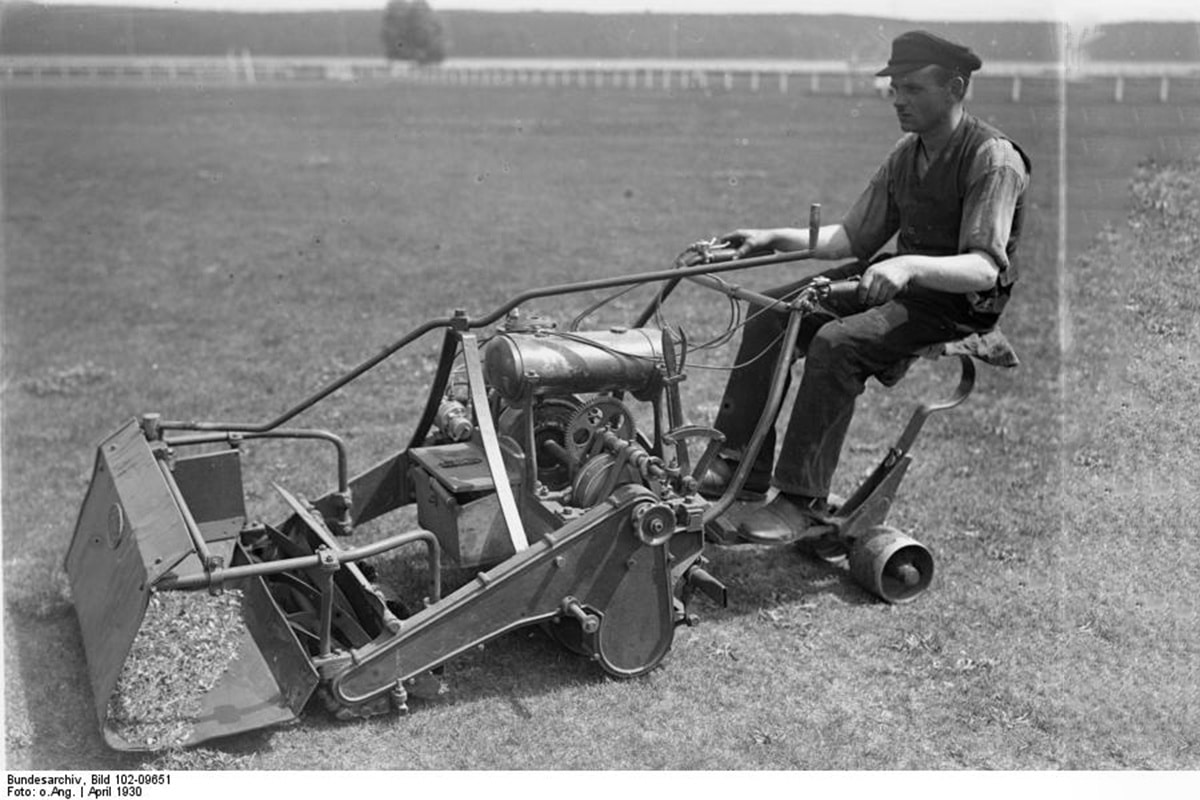
A black-and-white photo of a man, wearing a vest and cap, sitting on a large, mechanical mower
As this photo from 1930 shows, riding mowers have been around a long time.

Since then, mowing technology has come a long way, but just like Beard’s original invention, the majority of today’s mowers still require someone to drive or push them. But not for long.

Robotics Enter the Picture

The first robotic mower made its appearance the same year that Apollo 11 landed on the moon. In 1969, Spencer L. Bellinger, another intrepid engineer, created the first retail robotic lawnmower. Dubbed the MowBot, it operated through a signal wire that set the boundaries for operation. According to a New York Times article from that era, “. . . the mower [is] entirely safe and so quiet that it can be operated at night.” At the time, however, the MowBot was seen more as a whimsical gadget than a practical piece of landscaping equipment.

That started to change in the 1990s, when more advanced robotic lawnmowers made their debut. In 1995, Husqvarna developed a modern-style, solar-powered version of the self-driving machine. It featured several improvements over its predecessors, including enhanced programmability, smartphone control, and autonomous obstacle avoidance. This time, robotic lawnmowers were taken seriously, leading to further technology advancements. By 2005, robotic lawn mowers represented the second largest category of domestic robots.

Mower technology continues to develop at a fast pace, as more companies enter the market. According to the IBIS World Landscaping Service Industry Report, the landscape service industry is a $129 billion enterprise. Not surprisingly, many companies want to tap into this lucrative market, and they’re doing it with robotic mowers that offer a host of benefits for commercial landscape maintenance.

Because they run on batteries, self-driving mowers are quieter than their gas-powered, human-operated counterparts.

Addressing Labor Shortages in Commercial Landscape Maintenance

Approximately half of a company’s landscaping budget is spent on labor—assuming the company can find that labor. According to the 2021 Green Industry Benchmark Report, attracting and retaining employees is still the landscaping industry’s biggest problem, with 70% of landscapers reporting difficulties in finding employees. While a self-driving mower still requires some minimal human interface, it’s estimated that in many instances it can reduce labor costs by 90%.

The National Association of Workforce Boards—an organization that connects workforce professionals with Washington, D.C. policymakers—welcomes these advances. “We are embracing technology more than ever, with no fear of worker displacement. Autonomous mowers keep the turf maintained, freeing up workers to focus on more skilled tasks, such as pruning and plant diagnostics,” the association says on its website.

And saving on wages isn’t the only cost benefit of self-driving mowers. Scythe Robotics, which manufactures autonomous lawnmowers, claims the typical landscaper needs to replace a gas-powered mower every three to four years. Although self-driving mowers can be expensive up front, most are electric and so are more economical in the long run, due to longevity and reduced maintenance (no spark plugs, gas, or oil required). Scythe even offers a pay-per-acre model to its customers.

Other companies, like Graze Inc., function on a hardware/software model. The purchaser makes an initial investment in equipment, and then makes a monthly service payment for the software to keep the mower up to date and functioning. Graze claims an investment in one of their machines will increase a landscaping company’s profit margins by fivefold. Another seller of these autonomous machines, Turflynx, claims that switching from traditional to self-driving mowers reduces energy consumption by 80% and maintenance expenses by 40%.

The Eco-Friendly Solution for Commercial Landscape Maintenance

Electric self-driving mowers also have benefits for our planet. According to the U.S. Environmental Protection Agency (EPA), landscaping equipment engines produce up to five percent of our national air pollution. In fact, the California Air Resources Board reports that operating a commercial gas lawnmower for one hour emits as much pollution as driving a passenger car for about 300 miles. Statistics like this are motivating more companies to adopt electric self-driving mowers.

In general, companies today are searching for more sustainable approaches to facilities maintenance. Many have already turned to eco-friendly solutions for cleaning, so eco-friendly landscape maintenance is a logical next step. Fortunately, these businesses now have more practical choices in electric equipment, as battery technology has drastically improved over the past several years.

The Future of Commercial Landscape Maintenance

Adding convenience, cost savings, and other benefits to a company’s landscape maintenance routine doesn’t require sacrificing a beautiful exterior. While some businesses may be hesitant to use new technology such as autonomous mowers, others are embracing it.

In April 2022, the City of Glendale kicked off a pilot program with Graze, in which park staff will test and provide input on Graze’s automated electric mowing equipment. Glendale mayor Paula Devine promoted the partnership, saying, “Well, this is certainly an exciting day for the City of Glendale as we are the first—the very first—to partner with Graze.”

How quickly companies adopt self-driving mowers for their commercial landscaping and maintenance remains to be seen. But as autonomous mowers and battery-powered equipment roll out over the next decade, many expect that the majority of companies will start to embrace this cutting-edge technology. The benefits—lowered costs, increased sustainability—are just too significant to ignore.

A Facilities Management Partner You Can Rely On

No matter what technologies you prefer for your landscape maintenance, our award-winning service can help you maximize savings, manage resources, and plan for the future. Contact us today to learn more.

Managing multi-family properties isn’t really magic, but Jesse DiCamillo, Business Development Manager of Commercial Facilities at PRIDE Industries, makes it seem that way. By day, it’s all business for Jesse. But after hours? He transforms into Magician Jesse Dee—a persona he’s inhabited for over four decades, performing at myriad venues, including L.A.’s famed Magic Castle.


When we asked about his top six tips for managing multi-family properties, we were struck not only by his wealth of knowledge, but also by his flare for turning the ordinary into something marvelous. So, without further ado, here are six tips—The Amazing Jesse Dee style—to thrive as a multi-family property manager.

1. Make dirt and clutter disappear.

According to Jesse, “Any property is judged based on its cleanliness.” It makes sense. The pandemic underscored the ways in which cleanliness is linked to safety. Moreover, research illuminates the ways that clean, tidy spaces enhance mental health. Given its importance, cleanliness should begin (much like a good magic trick) with a plan, and a long-term one at that. Develop a maintenance schedule, one that factors both indoor and outdoor spaces and levels of usage throughout the day and night. And maintenance doesn’t stop there. It includes the tools and machinery used to clean those spaces. Preventative maintenance of vacuums, pool pumps, and robotic cleaning devices will mean less downtime—resulting not only in spaces that are clean, but also in lower costs associated with breakdowns. Cleanliness takes more than the wave of a wand, but so does all the best sorcery.

2. Prioritize teamwork, and presto!

Jesse encourages a facilities management culture of teamwork, where no one has an “it’s not my job” attitude up their sleeves. Garbage cans are overflowing, but it’s not your area to clean? Within a culture of teamwork, cleaning staff members won’t think twice about emptying it. A spill in the rec room? Whichever staff member has first availability will leap in to clean it. And how do you build and maintain a culture of teamwork? It begins with thorough training—providing enough information to empower employees to be self-reliant decision-makers. When employees are well-trained, they are equipped to meet high expectations, so set them, yes, but also provide support so that they are attainable. Cultivating a foundation that supports teamwork—undergirded with integrity, inclusion, respect, and a commitment to clear and honorable communication—is also vital. 

3. Spotlight productivity.

“Recognition and reward programs are a great way to improve productivity and performance,” says Jesse. Much like any successful magic show requires a spotlight—one that’s directed at the right person at the right time—so does business success. And recognition doesn’t need to be elaborate. A simple certificate, a callout in the property’s newsletter, or even a lunch is enough to show employees that they are seen. Given that property maintenance and custodial work often take place behind the scenes, ensuring your employees’ visibility becomes all the more important.

4. Nobody will really be cut in half.

“It’s about building trust through communication.” Like all good magicians, Jesse knows, first and foremost, a trust-based relationship must be established with those in the room. When the audience knows that a saw will be employed or flaming arrows flung, they need to trust that the magician has everything under control. The same is true in the world of multi-family property management. Communication needs to be regular and consistent. Actions need to follow words. Relationship building is also proactive. Try to get ahead of potential issues and solve them before they become major issues.

5. Timing is everything.

“Timing—and timelines—are an imperative part of operational planning,” Jesse says. When it comes to magic, a timing misstep can be the difference between success and failure. But timing is also vital in business, especially when it comes to keeping a property clean and tidy. Wait too long to clean, and you’ll have clutter at best, and a safety hazard at worst. Clean a particular space too often, and you’ll waste products and hours that could be spent on other tasks. Keep a timeline in place, with measurable goals. To meet those goals, foster a culture of supportive accountability. To pull off the best magic, everyone on stage needs to know not only what to do . . . but when to do it.

6. And, poof, help appears!

“Today’s tenants expect instant availability.” Remember that trick where someone appears, poof, as if out of nowhere? Responsiveness is especially important with residential properties. Because tenants are present 24 hours a day (in many cases), requests can come at all hours. Technology has also created a higher level of expectation, when it comes to property managers and maintenance staff. The good news is that property management tools—automation software and cloud technologies—make this wizardry easy to pull off.

So, there you have it. Six tips for managing multi-family properties—proof that making magic, whether on stage, in an apartment complex, or in a commercial facility, requires a practical approach. In other words, at the end of the day, magic is real.

Need help with your facilities operations?

PRIDE Industries can help you with facility operations, custodial and maintenance services, job assistance, and other services.

The word “retrofitting” can often send a shudder down the spine of owners or facility managers. The potentially high price tag, disruption…is it worth it, what’s the ROI and how long will it take to recoup the costs? Will my customers and tenants appreciate and benefit from it? Well, there is one area where it really is worth considering using the “r” word—water-saving commercial toilets. Not convinced? Let’s look at a few of the facts to see what the deal is; we think there are some commercial toilet retrofits that will leave you feeling flushed (groan).

The Cost of a Flush

According to the EPA, the highest portion of end water use for most commercial facilities goes to bathrooms and restrooms at up to 40% of the bill. (Restaurants are the exception with dishwashing being the highest portion and restrooms coming in second at 31% of total water use.) And keep in mind that many municipalities charge for discharge, or sewage, as well, which means reducing your water volume saves both water and sewage costs.

Imagine if you could cut water and sewage costs by 20% or more and reap other benefits at the same time!

Well, here’s the good news. Not only is it possible to save on this portion of your eye-watering bill–you may also qualify for financial incentives to do so. But before we get to that, let’s look at the current state of commercial water usage, how we got here, and why some business owners and facility managers are already making changes to their buildings’ water usage. 

Water Saving Toilets and the Big Picture on Commercial Water Use

We know from data compiled in the Commercial Buildings Energy Consumption Survey (CBECS) that the average water use by a large commercial building is 7.9 million gallons a year—that’s 22,000 gallons per day. In fact, according to this survey, in 2012 the total water used by 46,000 large buildings was 359 billion gallons of water!

This is a lot of water at a time when, in California, water demand already outstrips supply, and the prediction by many experts is that there will be a 40% supply gap by 2030.

How did we get here? Well, back in the 1980s toilets were using as much as 5gpf (gallons per flush)—this was also a time when people with mullets, mustaches, and shoulder pads were driving around in cars that got as little as 16 mpg. As time moved on, the fashion got ditched (thank goodness), and cars now get 35 mpg or more—but we still have many of the same toilets. Simply put, toilet technology was not developed at the same pace as car fuel economy, leaving many buildings with the equivalent of 16 mpg cars in bathrooms and restrooms.

ROI – Show Me the Money

These older toilets (pre-1994) use 3-5 times more water than new water-efficient toilets, and as we said before, water use for commercial bathrooms can be as much as 40% of a water bill, so it’s easy to see how replacing just a few toilets can make a huge difference in water use and costs.

As an example, if a large office building with 2,500 occupants replaced its inefficient toilets and urinals with newer High-Efficiency Toilets (HETs) and placed aerators on standard faucets it would reduce water usage by almost 3.9 million gallons a year and $36,000 in water costs!

One Star Flush Performance

It’s true, not all first-generation water-saving toilets got five-star reviews. Low flush v.1.0 left many of us scarred from a bad flush experience. So, for those of you who have been quietly mouthing that water-saving toilets just don’t work, do not worry, current high-efficiency toilets (HETs) are not your mother’s low-flush toilets.

In the early days of water-saving toilets in the 1990s, a time when phones were bricks, real bricks were being put into toilet water tanks to try and save water. And to comply with laws introduced in 1994 that called for all new installations of toilets to be 1.6 gpf or less, some manufacturers followed the brick principle and only modified the tank size with no further redesign. No wonder there was dissatisfaction.

Where Soybeans and Toilets Meet

It wasn’t until 2002 that real testing and performance standards began to be established. In this year a program called Maximum Performance (or MaP) Testing was created.

And this is where soybeans come in. Specifically, soybean paste (hopefully, this does not require any further description). MaP labs have been busy at work, perfecting flush performance using soybean paste and toilet paper to measure exact grams-to-water volume ratios and publishing their results for manufacturers.

This, together with new advancements in design and technology such as modification of bowl contours that improve flushing and pressure-assisted flushers means HETs are superior to the first-generation of water-saving toilets.

Water Saving Toilet Rebates Available

So now we know that HETs are going to work and save on water costs, let’s take a look at some of the incentives to help with the cost of replacing old toilets.

Here is a list of some of the commercial toilet rebates currently available:

  • California Water Service is offering rebates of up to $400 per unit for HET toilets and urinals for water districts across California.
  • Seattle Public Utilities in conjunction with the Saving Water Partnership are offering up to $100 per toilet for business, commercial, and multifamily buildings. Toilets have to be pre-2004 and replaced with new high-efficiency, high-performance toilets.
  • SoCal Water Smart offers rebates of $40 for toilets and $200 for urinals that are high efficiency. Covers many counties in Southern California.
  • In San Mateo County, the North Coast County Water District offers owners and managers of commercial buildings up to $60 per toilet for HET replacement.
  • Placer County Water Agency is also offering incentives for commercial buildings to replace toilets and half the amount of water used in each flush. They offer up to $50 to switch to waterless or low-flush urinals, and up to $50 for replacing toilets that flush 3 gallons per flush (gpf) with HET toilets that use 1.6 or 1.28 gpf.
  • In Florida, Conservation Pays is offering up to $100 per toilet for commercial buildings in counties across the state for replacement HETs that use 1.28 gallons per flush or less.
  • The City of Sacramento is offering up to $250 to replace pre-1992 toilets in commercial buildings with water-saving HETs that use 1.28 gpf or less.
  • San Luis Obispo – Offering up to $100 to replace existing fixtures with HETs and/or urinals.

And the Even Bigger Picture on Water Use

The fact is, the rise we see in water bills can only be reduced by less use. Conserving water now will help to lower water rates in the future by reducing the amount of money municipalities have to spend on bringing in more water. While cutting back on water can sound as groan-inducing as being told to go on yet another diet, cutting back on water use and mitigating the risk of water scarcity can become a competitive edge for your company. Water shortages from high water use have made many business owners aware that water scarcity, droughts, and water tables dropping means reducing their operational water footprint is a must.

Finding a Water Saving Retrofit Partner

Our facilities management teams have helped hundreds of commercial property managers upgrade toilets and find even more savings beyond rebates through our relationships with municipal water and wastewater agencies–in some cases covering the entire cost of retrofitting a building.

Commercial landscaping. It’s one of those services that can be taken for granted—until it falls short. You may not hear from occupants when they appreciate the blooming flowers, but you will know when someone slips on wet leaves or must constantly duck to avoid overgrown shrubbery.

And let’s not forget, your commercial landscape upkeep isn’t just about the building’s curb appeal. It’s the parking lot at the back, walkways, driveways, gutters, and keeping all areas trash-free and clean. All these services run in the background, keeping your grounds in good condition and appealing to tenants and customers—but when things are not done right, lack of service comes front and center. So, what are the key elements needed to keep your grounds in top condition and ensure tenants are happy?

We’ve done the groundwork (get it?) and compiled a list to guide you.

Commercial Landscaping—It's Personal

We’ve said it before, but it doesn’t get old—relationships are important. That goes for the relationship between the property manager and the landscaper and between the landscaper and the grounds they take care of. Develop a relationship with your landscaper and walk the property with them. They should be familiar with what is growing well and what needs attention—and happy to tour the property grounds with you to talk about what is being done and what to expect in the upcoming season.

Reputation and Experience

The number of years a company has been in business can be a good barometer of quality. (Let’s face it, nobody stays in business for years by doing a bad job.) Equally important is employee experience and training, a company with well-seasoned and well-trained staff is more likely to deliver high-quality services and meet your expectations. Check a company’s website and see how long they have been in business. Look for reviews and feedback from past clients to get an idea of the landscaper’s reputation.

Courtesy and Communication

With so much change around where people work: the office building, the home office–or both depending on the day of the week–communication regarding landscaping schedules is even more vital. Good lines of communication regarding jobs being done outside of regularly scheduled maintenance will prevent surprises. No one wants to drive into the office for a meeting to find walkways and parking lots being deep cleaned, leaving street parking and climbing over flowerbeds the only options for getting into the building. Courtesy also includes polite and professional uniformed gardeners and workers who are willing to answer tenant queries and address concerns.

Range of Commercial Landscaping Services

Landscaping is more than mowing and blowing. It is seasonal and varied. Depending on the property, lawn care, tree and shrub care, irrigation, hardscaping, and trash removal in parking lots and dumpster areas may be part of what your property needs. A company that provides a comprehensive range of services can help you save time and money by handling all your landscaping services. Talk through the services your property requires to ensure everything is covered by your landscaper.

Environmentally Aware

Sustainability is becoming an increasingly important consideration in commercial landscaping. It is good for the landscape and customers often demand it. Today the best environmentally friendly practices include the principles of IPM (Integrated Pest Management). Landscapers who implement these practices use materials such as native plants, organic fertilizers, and chemical tools to minimize environmental, health, and economic risks. With these principles, a landscaper familiar with your property and goals can provide advice on how to conserve water and energy, reduce waste, and improve the overall sustainability of your property.

Proactive and Preventative

Seeing the big picture is always necessary but paying attention to small details and acting on them can be crucial. Keeping an eye on details and being proactive can prevent escalation to a larger problem. Overgrowth into building air conditioning units, signs of pest infestation, leaking, and poorly timed irrigation if spotted early are a lot easier to deal with. Prevention is particularly vital when it comes to your property’s outdoor water use. For example, an irrigation system that uses sensors rather than timers can prevent over-watering that can kill plants, waste valuable water, and lead to higher bills.

Capability and Compliance

These two things should go hand-in-hand. Merely having the capability to complete a task is not enough. When liability and safety are on the line compliance with standards is a must. Okay, less important when it comes to picking spring flower colors–but necessary for many other services provided by a landscaper. Improper compliance when it comes to tree trimming, or pesticide and fertilizer use, for example, could impact the safety of building occupants and the long-term health of your grounds or gardens. Your landscaper should be licensed, insured, and bonded, and staff should be well-trained in safety procedures.

Expertise and Knowledge

With the right landscaper, you do not need to know tulips from thistles, or even a mower from a blower (okay, that is a bit of a stretch). Picking a landscaping company with broad expertise and deep knowledge across multiple topics will mean getting the most out of your outdoor space and sustaining satisfied tenants.  To be assured of a landscaper’s qualifications check for certifications such as the National Association of Landscape Professionals (NALP) Landscape Industry Certification, and the International Society of Arboriculture (ISA) Arborist Certification. Certifications such as these require standards of professionalism, up-to-date knowledge of materials and regulations, and continuing education.

Available and Reliable

Nothing says good service like availability and reliability. Whether it’s concerns about damage from a storm or just to discuss aesthetic changes, calls to your landscapers should be responded to promptly.  And when extra tasks or jobs are scheduled, you should be able to count on service personnel showing up and getting the job done.

Remember It is Seasonal, and Year Round

Do not fall into the seasonal trap. Yes, commercial landscaping services change as the seasons do, but reducing work during winter or fall will be detrimental to the landscape and your leasing potential. Good landscaping follows a year-round calendar and specifies when certain tasks need doing such as trimming perennials, laying mulch, and when annuals are planted. Not only will cost cutting in one season be apparent to tenants, but it may also harm long-term plant health and mean more work is required the following season.

At its best, when commercial landscaping services are professional and efficient, it can appear to tenants and employees that the landscape just, well…looks after itself. A case when hearing crickets means an excellent job is being done.

Professionalism. In business, we know it’s important—all the more when daily face-to-face interaction with customers is necessary. In fact, when it comes to commercial property cleaning, professionalism can make the difference between keeping and losing tenants and/or customers. But what, specifically, does commercial cleaning professionalism look like?

Turns out it’s pretty simple.

10 Characteristics of Commercial Cleaning Professionalism

Here are 10 characteristics of professional commercial property cleaning team:

  1. Shows up to work on time.
    Custodial staff members are where they should be when they should be. What this translates to is readiness. When the doors open, the building and its spaces will be ready to function for their particular purposes. All areas will be ready for tenants and customers to do business comfortably and efficiently. Throughout the day, a professional commercial property cleaning team will manage time efficiently.
  2. Is attired appropriately for the role.
    While it’s true that the post-pandemic dress code is more casual, customers still care how their business providers are dressed. In fact, studies conclude that dressing more formally for a role engenders trust and respect from others. Benefits abound for the wearer, too. More formal attire (including uniforms) has been strongly associated with enhanced big-picture, long-term-goal oriented thinking.
  3. Is courteous.
    In a nutshell, this means that they demonstrate regard and basic respect for others. Polite language— “please,” “thank you,” “excuse me”—goes a long way. Courtesy extends to nonverbal communication, too. From posture to smiling to the granting of personal space, what we do with our bodies speaks volumes.
  4. Is helpful.
    Professional custodial team members are willing to go the extra mile in order to satisfy customers. They anticipate potential concerns and are proactive in addressing them. For instance, PRIDE Industries custodial superstar at Sacramento Metropolitan Airport, Eric McCullough, regularly takes time to escort airport customers to where they need to be.
  5. Is accountable.
    We’ve all experienced the “it’s-not-my-job” employee. A professional property management organization works as a team across roles, if necessary, to accommodate the customer. They view the customer’s problem as theirs to solve. In short, they do not pass the buck.
  6. Takes pride in their work and in the “power of clean.”
    They understand that the building is an “ambassador” for its owner and for the businesses inside of it. Studies show that clean, tidy spaces boost the mental and physical health of occupants. A professional commercial property cleaning staff understands this. Moreover, they view their work’s quality as a reflection of their own work ethics.
  7. Is trustworthy.
    Custodial crews often are among the first in or out of a building, working without supervision and often in contact with occupants’ personal items. So, it’s imperative that they are honest. It’s also important that they are alert and aware, able to notify security when suspicious activity arises—especially during quieter operational hours.
  8. Is well trained for the environment.
    Not all buildings and their uses are created equally. For example, the California Health Care Facility mandates hospital-standard cleanliness to maintain licensure, so custodial staff must be trained in these specific protocols. Additionally, staff must understand the chemicals they are using and how to use them properly for their own and others’ safety.
  9. Ensures safety.
    The pandemic heightened public awareness and expectations about what constitutes safety—an evolution that is here to stay. Not only does a professional commercial property cleaning staff keep things clean, but it also keeps them safe. This means disinfection products and protocols and, where necessary, personal protective equipment (PPE). This also means that custodial staff make sure their equipment and chemicals aren’t positioned in a way that they could inadvertently pose a safety hazard to occupants.
  10. Is up to date with technology.
    Whether it’s garbage can sensors or robotic cleaning devices, technology has made its way into commercial property cleaning. As tech will only become more abundant in the custodial field, professionalism means that management knows when and where to implement it and provides training to this end.

Commercial Property Cleaning can be a Differentiator

As the hybrid work model continues to decrease tenant occupancy, property managers need every competitive edge to retain good tenants. The building next door may boast a koi pond, but will that matter to customers if they’re also met with grimy floors and disinterested cleaning staff? A commercial property cleaning staff that’s consistently professional will not only attract tenants, it will keep them.