Our Stories

For most of the twentieth century, facilities managers ran their operations with only rudimentary technology. Even railyards and other sprawling facilities were managed with tools that were rarely more sophisticated than paper or punch cards. Then, in the latter part of the century, many large companies adopted a new technology known as a computerized maintenance management system (CMMS). And by the nineties, CMMS software had become inexpensive enough to be a viable option even for smaller companies.

In the decades since, CMMS software has become even more robust, so that today this indispensable technology offers a hefty advantage to those companies looking to streamline operations. The software has found a home in multiple industries, and now whether you operate a complex gas plant or a single office building, this technology can help ensure the safe and efficient functioning of the facility’s equipment, machinery, and building envelope.

Used properly, CMMS software can provide value well beyond paperwork organization and work order management.

Defining CMMS Software

CMMS can also be referred to as CMMIS (computerized maintenance management information system), and is sometimes used interchangeably with EAM (enterprise asset management) or even APM (asset performance management). However, while there are areas where these technologies overlap, there are also some key differences.

Enterprise Asset Management (EAM)

The goal of an EAM system is to optimize an asset’s lifecycle. It enables a holistic approach to managing asset performance from cradle to grave, one that goes beyond tracking maintenance schedules to include planning for the timely decommissioning and replacement of assets.

Asset Performance Management (APM)

APM, although it shares many features with CMMS, is concerned with analyzing the performance of building assets to increase productivity and minimize risk.

Computerized Maintenance Management System (CMMS)

CMMS is dedicated to optimizing MRO (maintenance, repair, and operations). CMMS software is designed to track maintenance activities and scheduling costs. To maximize a facility’s MRO, CMMS software automates the management of workflows, optimizes routing, and enables organized recordkeeping for reporting and auditing.

By gathering disparate information and data into one container, CMMS tools provide facility managers with an easy means by which to schedule and track work orders, a task that, pre-automation, was tedious and time intensive. Used properly, CMMS software can provide value well beyond paperwork organization and work order management.

Two technicians, one holding a laptop and the other holding a tablet, standing at a piece of machinery in an industrial facility
CMMS software can predict when maintenance is required and automatically generate work orders.

Maximizing Maintenance and Improving Operations with CMMS Software

CMMS software can make facilities management easier and more effective by increasing productivity and optimizing operations across multiple areas:

Workforce Productivity

CMMS software can streamline communication between maintenance teams and other departments. This results in better coordination, quicker response times, and increased productivity, since personnel can focus on their tasks without unnecessary delays caused by disorganized processes.

When CMMS algorithms predict that maintenance is required, the system can automatically generate work orders for necessary tasks. This proactive approach ensures that maintenance teams are informed well in advance of a needed operation, allowing them to plan and execute maintenance activities without disrupting regular operations.

Predictive Maintenance

Regular preventive maintenance has long been the cornerstone of modern facilities management. But today, new technologies are enabling facilities managers to be even more forward-thinking in their management practices, and embrace what’s known as predictive maintenance.

New, advanced sensors and monitoring devices, attached to critical equipment, can now offer real-time data on the condition of machinery. This crucial performance and condition data include temperature, vibration, and even pressure. CMMS software then analyzes this data to provide insight into the health and longevity of a facility’s assets, helping maintenance teams predict when equipment might require attention.

Downtime Reduction

Advanced sensors and monitoring devices offer real-time data on the condition of HVAC, plumbing, and other assets.

Equipment downtime, which often causes disruption and lost productivity, is often more expensive than any repair. According to a study by Deloitte, inadequate maintenance procedures can reduce a facility’s overall productive capacity by up to 20 percent.

By analyzing usage and performance patterns, along with historical data and current operating conditions, CMMS software can forecast potential issues and recommend preventive actions. In this way, the system can identify early signs of deterioration or discover unexpected anomalies, so that maintenance crews can investigate and repair, avoiding a breakdown that interrupts normal operations.

Whether your maintenance strategy is preventive, predictive, or a combination of both, CMMS technology can automate work orders and maintenance schedules to reduce asset downtime and extend equipment life, thus enhancing overall operational efficiency. Uninterrupted uptime means production continues, deadlines are met, orders are filled, and customers or occupants remain happy.

Metrics and Analytics

The task of tracking and managing all the parts that make up a facility can be complex, which is why having real-time access to comprehensive data is one of the biggest advantages of maintenance software. This data not only facilitates quick decision-making, but also ensures that all stakeholders are well informed about the status of equipment, work orders, and overall facility health. It ensures that assets are utilized optimally, and replacement decisions are based on sound analysis.

CMMS analyses also enable companies to optimize spare parts management. Instead of either maintaining excess inventory or facing shortages, businesses can manage their spare parts stock based on actual usage patterns and predicted maintenance needs. This minimizes deliveries and the overstocking that leads to wasted parts, which in turn not only reduces costs, but also the facility’s ecological footprint.

Consistency and Compliance

CMMS software can make regulatory compliance easier by compiling the extensive data and documentation that are needed to prove adherence to laws and regulations. Computerized maintenance systems have the ability to create audit trails by building documentation from logged work order history, gathering the information needed to pass audits, and even submitting records to prove compliance via electronic signature. This not only saves valuable time, but also offers greater accuracy and timely submissions.

Emission Control

Another benefit of monitoring assets for performance is the ability to identify emissions, energy use, or hazardous leaks that may affect the environment, building occupants, or customers. With CMMS software, a facility’s energy usage can be monitored in real time. Blips in usage serve as an alert that enables maintenance crews to investigate a potential problem before it escalates, so that the facility consistently maintains energy efficiency across operations. Facility managers can also leverage energy usage data to assess the environmental impact of operational practices and implement strategies to improve sustainability.

When CMMS Doesn’t Work

As with any technology, when it comes to using CMMS software, the adage “garbage in, garbage out” applies. Technological innovations can improve facility operations, but behind every piece of technology is a human hand. It’s vital that the technicians who use CMMS software are fully trained and knowledgeable, so they can avoid errors and fully leverage the CMMS tool. In order to make sure your CMMS system yields the best results, it’s important to keep three factors in mind:

Integration challenges

Integrating CMMS software with existing systems, such as enterprise resource planning (ERP) systems or building management systems (BMS), can be challenging. Compatibility issues may arise, requiring additional time and resources for seamless integration.

Learning Curve

When implementing a new CMMS, be prepared for a learning period that could temporarily affect productivity. Remember that in addition to the personnel who interact directly with the CMMS software, ancillary staff will also require training.

Data Security

Storing sensitive operational and maintenance data on a digital platform raises concerns about data security. Facilities need robust cybersecurity measures to safeguard against potential breaches that could compromise critical information.

Going Forward with CMMS Software

Advances in CMMS software have the potential to provide transformative leaps in efficiency, sustainability, and predictive maintenance. In the hands of knowledgeable managers and technicians, facility management software offers a centralized hub for all operations, increasing efficiency in MRO scheduling, data management, and asset tracking. The foresight provided by real-time monitoring and predictive analysis ensures that potential issues are addressed before they escalate, minimizing downtime and increasing cost savings.

Although there may be hurdles and hiccups in implementing or upgrading to a robust management system, CMMS software offers businesses operational resilience, enabling them to create and maintain sustainable, cost-effective, and future-ready facilities.


Expert Facilities Management for Optimal Efficiency

Looking to bring greater automation to your facilities maintenance? PRIDE Industries can help. With more than 35 years of facilities management experience, and expertise in the latest management technologies, we can help you minimize energy consumption, reduce waste, and optimize the value of all your facility’s assets.

From skyscrapers to manufacturing plants, across all types of industries, and in companies both large and small, facility asset management is the quiet but vital linchpin responsible for optimizing operations, maximizing asset lifecycles, and contributing to a company’s bottom line.

Facility asset management is a broad service that encompasses multiple obvious and not-so-obvious aspects of a business’ day-to-day functions. When operations are running seamlessly it’s easy to forget about facility asset management, especially when it’s handled by a third party. But when things go wrong, the important role of the facility asset manager—and how it affects business efficiency—becomes apparent. This is why it’s so important to pick the right facility asset management service for your company.

Facility Asset Management—What’s Involved?

So, what are facility assets? The precise answer can vary, depending on the organization, but facility assets are generally thought of as those that affect the day-to-day operations of the business and support occupants’ needs inside buildings and on the grounds outside of the facility.

In a Berkshire Hathaway survey of companies across multiple sectors, 70% reported losing productivity due to unexpected asset repairs and replacements.

Traditionally, these assets have been considered the tangible and physical items in a facility. However, with the expansion of technology, intangible assets such as CMMS (computerized maintenance management systems) and HVAC fault detection and diagnostics may also fall under the purview of facility asset management.

Some experts have defined facility assets as anything that needs to be maintained at least once a year or is valued at more than $5,000. While these may be good additional guidelines, relying on a dollar amount or a maintenance standard may miss some critical assets—or conversely, include less relevant ones, depending on your facility.

The official definition of a facility asset comes from ISO 55000, set by the International Organization for Standardization. This standard defines an asset as “an item, thing or entity that has potential or actual value to an organization.” Asset management is defined as a discipline that helps to “better achieve organizational objectives while realizing greater value from their assets.”

In other words, assets are items with actual or potential value to the facility that would cause disruption to operations or business objectives when not functioning. Since ISO recommendations are considered the gold standard for best practices in areas such as quality control and safety, this definition of asset management is a good reference point, so if in doubt, referring to ISO 55000 is a good bet.

Strategies, Methods, and Best Practices

Expert facility asset management is crucial to maximizing the longevity and productivity of your capital assets. To achieve this outcome, a facility’s asset management program should include the following:

Comprehensive Asset Inventory

The first step in effectively managing your assets is to have comprehensive information on each one. That means every asset is tagged and barcoded, and its identifying information is entered into a tracking system that’s accessible by all those who need it. Having up-to-date and organized records of all facility assets promotes informed decision-making. While the labor and time involved in reconciling incomplete or inaccurate data may seem daunting, the effort will be rewarded with less disruption in the long term and greater insights into your facilities’ operations.

Lifecycle Planning and Management

Lifecycle planning is a core part of facilities asset management. Being able to identify when assets are nearing the end of their life and developing strategies around asset lifecycles can provide significant cost savings for your organization.
A technician in hardhat, goggles, and safety vest, standing in front of an industrial HVAC configuration, looking at a laptop
Having up-to-date and organized records of all facility assets promotes informed decision-making.

In fact, a global report on asset management from Deloitte found that the aging of facility assets is a major risk for many companies. But this same report also found that businesses that are able to effectively calculate the lifetime of their assets spend substantially less on reactive maintenance. This is just one way that a robust facilities asset management program can bring greater predictability and value to an organization.

Experienced asset managers know how to analyze annualized ROI to optimize facility investments. To make informed decisions on asset replacement and repair, facilities managers should assess the totality of every asset’s cost: from design, procurement, installation, and startup; through operation and maintenance; and finally, to decommission and removal. In this way, assets can be compared equally, and plans can be made accordingly.

The Power of Analytics to Inform Decisions

Digging into historical and performance data to discover trends, make predictions, and engage in proactive problem-solving can be powerful. By analyzing historical asset performance, trends and patterns can be identified, enabling proactive recommendations, preventing costly breakdowns, and extending the lifespan of the facilities’ assets. Relevant data should be drawn from all sources, including the manufacturer’s history, as well as the asset’s performance and maintenance records.

Compliance and Regulations

Whether it’s safety standards, environmental regulations, or industry-specific mandates, being well-versed in the regulatory landscape and ensuring that assets and operations align with legal requirements must be a priority in facilities management. Failing to comply with environmental and other regulations can have serious repercussions, such as a damaged reputation among customers, and even—in rare cases—legal costs.

It’s essential that every asset in the facility—and the facility as a whole—comply with ICC, OSHA, EPA, and other government regulations. Regular training of in-house technicians is a must to ensure that they are up to date on regulations and keep stringent records.

But it’s not enough for your team to be in compliance, you must also ensure that your third-party vendors and service providers are compliant. Assets serviced by third-party vendors who are non-compliant can come back to bite you. To avoid this scenario, facilities managers should communicate regularly with vendors about compliance issues, and gain as much insight as possible into a contractor’s record. Be prepared to switch providers if there are serious or continuous non-compliance issues—your reputation depends on quick remedial action.

Technology-Aided Predictive Maintenance

Facilities management providers can fall into the trap of reactive maintenance. But a proactive approach is best for the bottom line, as preventing an asset’s failure is less costly than repairing the asset. And predictive maintenance can yield even greater savings, as it takes the forward-looking approach of proactive maintenance to a new level.

If reactive maintenance is about the past, and proactive maintenance is about the present, predictive maintenance is all about the future. While “reactive maintenance” is essentially a synonym for “repair or replace,” and proactive maintenance involves monitoring assets for signs of wear and tear, predictive maintenance collects data about individual and aggregate assets to determine the best schedule for both maintenance and inspection.

Predictive maintenance is still a fairly new discipline, made possible by advances in data analytics and sensor technology. Technologies such as EAM (enterprise asset management) software and CMMS (computerized maintenance management systems) enable technicians to move away from reactive maintenance to a more predictive strategy of maintenance and repair.

Sometimes referred to as CBM+ (condition-based maintenance plus), these technologies use real-time data from sensors, together with machine learning (a type of artificial intelligence) to give facilities managers the information they need to gain greater insight into the condition of facilities assets, allowing for repair schedules to be optimized, and minimizing or even eliminating downtime. These high-tech tools are allowing an increasing number of companies to streamline and optimize facility operations.

Four Benefits of Facility Asset Management

How do the best practices of facility asset management benefit businesses and property owners? The gap between merely adequate facilities management and vigorous asset oversight can be wide.

Asset Performance

The principal thrust of facility asset management is to coordinate activity and efforts that will optimize asset performance. This is achieved through performance monitoring, lifecycle analysis, and predictive repairs that reduce downtime and extend the asset lifecycle.

At its best, facility asset management goes beyond maintaining the status quo to maximizing the potential of every asset. By optimizing performance, businesses can extract maximum value from their investments, directly improving the bottom line. In essence, robust asset management can transform assets from potential liabilities to long-term contributors to company value.

Improved Productivity and Cost Savings

In a Berkshire Hathaway survey of companies across multiple sectors, 70% reported losing productivity due to unexpected asset repairs and replacements. Asset ignorance is costly. In manufacturing alone, studies have shown that unplanned downtime costs companies an average of 800 hours of productivity every year.

Performance monitoring, lifecycle analysis, and predictive repairs reduce downtime and extend the asset lifecycle.

This is why it’s essential that the facilities management service provider you use be knowledgeable in proactive and predictive maintenance. Knowledgeable facility asset managers who compile comprehensive asset inventories, embrace proactive maintenance strategies, and provide asset lifecycle management can mitigate lost productivity and reduce costs.

Risk Mitigation and Enhanced Safety

The National Safety Council estimates that the total economic costs of work-related deaths and injuries in 2021 was $167 billion. Robust facility asset management can be a proactive shield against unforeseen risks by ensuring the proper functioning of machinery and equipment and implementing safety protocols that reduce the risk of accidents and breakdowns. Additionally, managers knowledgeable in their facility’s compliance needs can ensure assets and operations align with legal requirements. This not only mitigates legal risks but also fosters a culture of responsibility and accountability.

Sustainability

For any facility, identifying energy consumption, emissions, and areas where efficiency can be enhanced leads not only to improved operations but also to a more sustainable and eco-friendly facility.

By managing assets with sustainability in mind, eco-savvy facility asset managers can optimize energy efficiency, which not only saves money, but is essential in order to earn environmental certifications such as LEED (Leadership in Energy and Environmental Design). LEED is a coveted and globally recognized achievement of sustainability for all building types. By optimizing their building assets and operations, businesses have not only qualified for this certification, they’ve also reduced energy use by as much as 30%.

At a time when environmental responsibility is a business imperative, facility asset management—through energy-efficient practices, waste reduction, and adherence to sustainable standards—can contribute to the company’s ethos of responsible stewardship.

Holistic Gains

Facility Asset Management is crucial for ensuring facility assets don’t just function, but also contribute meaningfully to organizational success. When power plants run smoothly, or high-rise buildings function flawlessly around the clock, that’s often due to the meticulous strategies of a facility asset management team that combines knowledge, foresight, technology, and data to redefine operational excellence.

As industries evolve and businesses navigate the complexities of a rapidly changing world, excellent facility asset management becomes increasingly important. Now more than ever, a tech-savvy, holistic approach to asset management is an essential contributor to a company’s value.

Facilities Management Expertise You Can Count On

If you’re looking to optimize operations and gain the most from your facility’s assets, we can help. PRIDE Industries manages 13,000 buildings and has over 35 years of experience in facility asset management.

October is National Disability Employment Awareness Month and, amid the manufacturing skills gap—there aren’t enough skilled workers in the country—it’s a great opportunity to call attention to one of the most underused talent pools in the country—people with disabilities.

It’s no secret that labor shortages and high turnover rates continue to plague the manufacturing sector, with about 40 percent of employees calling it quits yearly, according to the Bureau of Labor Statistics—44 percent in 2020, 39 percent in 2021, and 40 percent in 2022. Turnover is a drag on productivity and the bottom line, with recruiting, onboarding, and retraining costing from $3,500 to $10,000 per employee.

According to the 2023 Career Advancement in Manufacturing Report, 82 percent of manufacturing companies are experiencing a labor shortage. The numbers don’t lie. Earlier this year, the U.S. Chamber of Commerce reported 693,000 open manufacturing jobs. Even more concerning: A study by Deloitte and the Manufacturing Institute found that the manufacturing “skills gap” could result in 2.1 million unfilled jobs, costing businesses a trillion dollars by 2030.

Diversifying Talent Pipelines to Ease the Manufacturing Skills Gap

Deloitte’s solution? Turn to underrepresented communities.

A landmark Accenture study found that companies that actively include employees with disabilities achieve 28 percent higher revenue, double the net income, and 30 percent greater profit margins than those that don’t.

“It is deeply concerning that at a time when jobs are in such high demand nationwide, the number of vacant entry-level manufacturing positions continues to grow,” said Paul Wellener, Deloitte vice chairman and U.S. industrial products and construction leader. “To attract a new generation of workers, the industry should work together to change the perception of work in manufacturing and expand and diversify its talent pipeline.”

Finding Hidden Labor Pools

When it comes to diversifying its talent pool, InterMotive Vehicle Controls in Auburn, California, is ahead of the game. Co-founders Linda and Greg Schafer were searching for an outsourcing partner to manufacture some of the company’s PCBAs in 2008 when they discovered PRIDE Industries, a contract electronics manufacturer with a mission to create employment for people with disabilities.

“The company’s capabilities blew me away,” Greg said. “The people, the processes, and the technology are state of the art. But what sets the company apart are the people—I’d never seen a manufacturing floor where employees were so happy to be there.”

Fast forward 15 years, and PRIDE Industries now manufactures 46 parts for InterMotive—24 cable assemblies and 18 mid to high-volume PCBAs. Services provided include functional testing of PCBAs, using custom test fixtures designed and built by PRIDE Industries engineers. Testing time has been reduced from about six seconds to 2.5 seconds, and returned boards have all but disappeared.

Retention Benefits

“We have directly hired people with disabilities and outsourced to PRIDE Industries’ teams for going on two decades now,” Linda said. “When you take someone with an intellectual disability or a physical disability, and assess their skills and interests, give them the training and support they need, you’ll be amazed at what they can do and how much they can contribute.”

Hiring people with disabilities helps InterMotive bridge the manufacturing skills gap and increase retention. “I have employees with disabilities who started after high school and are now married and buying homes,” Greg said. “They love their jobs, show up on time every day, and are proud of their work. They really enhance our workforce.”

But the story doesn’t end there. Coincidentally, one of InterMotive’s flagship products is a wheelchair interlock—a mechanism that immobilizes wheelchair-accessible vehicles when the wheelchair ramp deploys. “Some of our employees come to work in vehicles with our products on board,” Linda said, “products they may have helped build.” InterMotive is the largest manufacturer of wheelchair interlocks in North America.

A Vast Labor Pool

More than 10 percent of people aged 16–64 in the United States—22 million people—have a disability. The employment ratio for this population—the percentage who are employed—hovers around 30 percent, while the rate for persons without a disability in the same age group is about 75 percent.

But that’s changing, fast. In recent years, the employment-to-population ratio for people with disabilities has risen to record highs, reaching more than 37 percent, according to the monthly National Trends in Disability Employment (nTIDE) report, published by the Kessler Foundation and the University of New Hampshire.

Still, that leaves about 14 million people available for work.

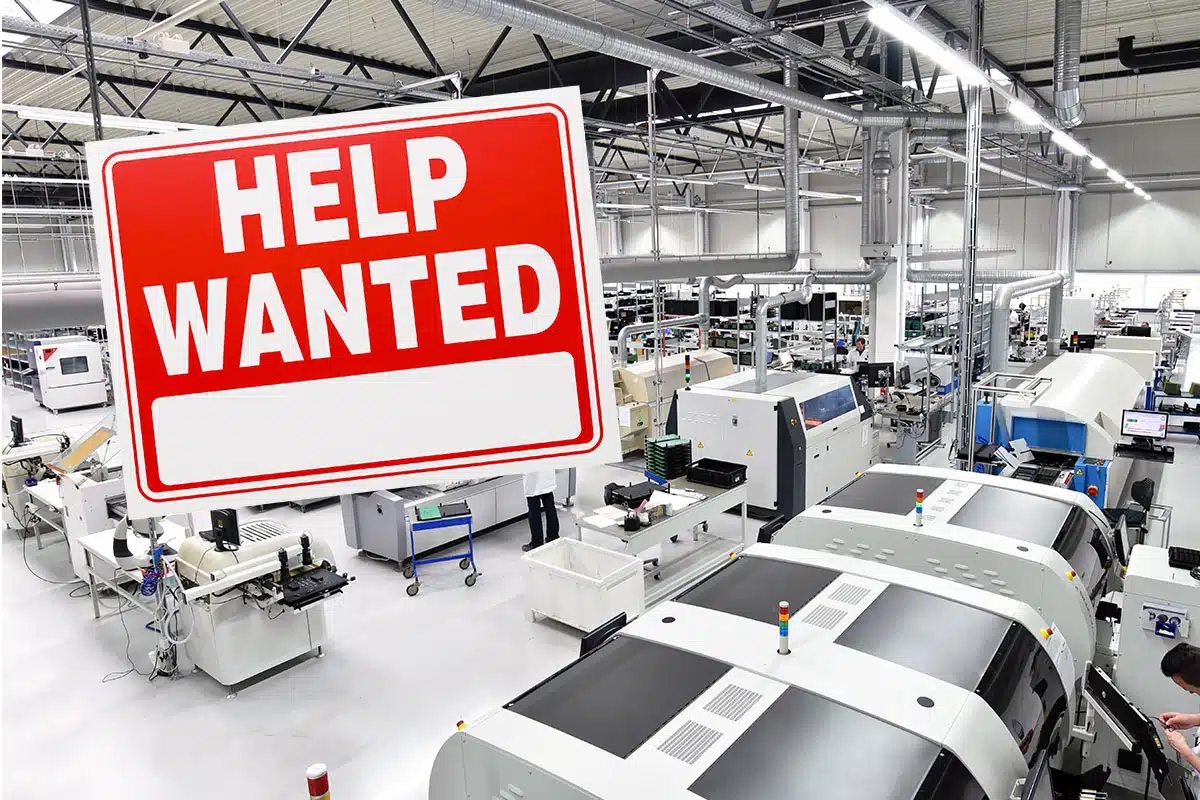
A Help Wanted sign affixed to a photo of the factory floor of an electronics manufacturing company
Amid an ongoing manufacturing labor shortage, smart companies are diversifying labor pools and discovering the gifts of people with disabilities.

Proven Benefits

The business benefits of a workforce that includes people with disabilities are proven, if not well known. A landmark Accenture study found that companies that actively include employees with disabilities achieve 28 percent higher revenue, double the net income, and 30 percent greater profit margins than those that don’t.

Research published by the National Institutes of Health found that the economic benefits of hiring people with disabilities include: lower employee turnover, greater long-term retention; increased reliability, punctuality, and productivity; and greater customer loyalty and satisfaction.

Low Risk, High Reward

One of the reasons some employers cite for not including people with disabilities is the added cost of reasonable accommodations that the Americans with Disabilities Act (ADA) requires. That myth is long busted. A survey of 3,528 employers by the Job Accommodation Network (JAN) found that 49.4 percent reported that accommodating employees with disabilities “cost absolutely nothing.” The other employers incurred an average one-time cost of just $300 per employee with a disability.

Meanwhile, the Society for Human Resources Management pegs the average cost of replacing an hourly worker at $1,500 each—far more than the cost of accommodating an employee with disabilities.

Keys to Success

Another reason some companies cite for not recruiting people with disabilities is simply a lack of knowledge about how to work with them. Again, this concern is unfounded, as the folks at InterMotive well know.

Keys to InterMotive’s success with employees with disabilities are consistent assessment, training, development, and feedback—processes the company has invested in for employees of all abilities for decades. “In many ways, these employees are just like any others that walk through our doors,” Linda said. “We identify their skills and interests, find the right role for them, and give them the training and support they need to be successful and find a career path here.”

InterMotive began hiring employees with disabilities long before DEI became trendy. “We aren’t doing this because someone told us we had to,” Greg said. “We’re doing it because it makes us a better business.” And he cautions companies against hiring from underrepresented communities simply to “check a box.” He said it requires investment, but once you make it, “you realize you are more alike than different.”

“They want to work. They want to contribute,” Linda said. “Their joy is a gift.”

“I'd never seen a manufacturing floor where employees were so happy to be there."—Greg Schafer, President and cofounder of InterMotive Vehicle Controls

Solve Your Manufacturing Skills Gap with PRIDE Industries

PRIDE Industries offers state-of-the-art facilities and a full suite of electronics manufacturing, packaging and fulfillment processing, and supply chain management services. And our inclusive workforce—about 50 percent of our employees have a disclosed disability—means that working with us allows you to make a positive social impact with your business spend, while meeting consumer demand for products made in the USA.

Jobs for people who are deaf can be hard to come by. But at Fort Bliss, where PRIDE Industries has provided a broad range of facilities management services since 2007, it’s different.

“From the very start, we hired at least one deaf individual,” said Cynthia Baca, Recruiting Manager for Talent Acquisition at PRIDE Industries. “By the end of the year, several deaf employees were working here at Fort Bliss.”

Today 41 deaf people work at Fort Bliss, thriving in positions that run the gambit from general maintenance work to supervisory roles.

People of All Abilities Deserve Access to Employment

Envisioning an inclusive world where people of all abilities have equal access to achieve their employment goals, PRIDE Industries knows that abilities come in all kinds of packages. And, every day, the Fort Bliss team puts this vision to work.

PRIDE Industries’ late CEO Michael Ziegler said it this way: “The magic that happens when someone who typically cannot get a job finally gets a job—it’s incredible. Their lives change.”

Barriers to Jobs for People Who are Deaf

Unfortunately, many employers maintain a bias that is a barrier to jobs for people who are deaf. According to the Yang-Tan Institute at Cornell University’s 2016 analysis, fewer than 40 percent of those with significant hearing loss work full-time. A 2019 study by the National Deaf Center found that only 53 percent of deaf people were employed overall. Even more troubling—this marks a steep decrease since the 1970s despite deaf individuals earning degrees at four times the rate they did then. Experts in the field attribute this to continuing discriminatory hiring practices, employer misconceptions, and unwillingness to provide basic accommodations.

After experiencing these barriers with his former employers, Jesus Rosales, Facilities Supervisor for the carpentry shop at Fort Bliss, found the opposite at PRIDE Industries.

“From the start, I’ve had access to interpreters and training that I didn’t have anywhere else,” he signed through an interpreter. “I saw that deaf people could be promoted to higher positions. There is no limit here.”

Work Control Specialist Christina Turon concurs.

“With my previous employer, there were a lot of barriers to accessibility. No interpreters. No alarms. During meetings, I’d try to watch my coworkers’ lips at the same time I was watching out for forklifts and back trailers. It was all very obstructing to my abilities.”

Christina contrasts that with her experience with PRIDE Industries at Fort Bliss.

“Here, it’s amazing,” signed Christina. “I feel supported. They provide interpreters. They understand Deaf culture. There’s more accessibility and learning opportunities. Everyone here communicates the way I do.”

They Speak My Language

It’s important to note that many in the Deaf community don’t view deafness as a disability but, rather, as a culture—a vibrant one with its own language: sign.

“That’s a big part of why I feel so motivated to come to work every day,” signed Jesus. “The people here speak my language and understand me.”

“They speak my language” is a refrain among deaf employees on the PRIDE Industries team. That’s because, in addition to the Deaf community using it, the Fort Bliss job coaches are all trained in sign language.

While Deaf culture includes an emphasis on sign language, it doesn’t stop there. According to the World Federation of the Deaf, it includes “beliefs, attitudes, history, norms, values, literary traditions, and art shared by those who are deaf.”

That culture is alive and well at Fort Bliss.

“During Deaf Awareness week, the team organized and attended a number of local events,” said Cynthia. “They reached out to the community as well—to include interpreters, members of the sign club, and college students.”

A Work Ethic That Generates Results

The team’s work ethic is also on point, as is its capacity to generate excellent results.

So notes Tim Young, PRIDE Industries Vice President of Talent Management, who has spent the bulk of his career working in customer service environments.

“There’s a misconception out there—that the level of execution, performance, operations, and customer service would be different with an organization like PRIDE Industries,” said Tim. “And it’s not. All our employees provide a very high level of service.”

Specifically, at Fort Bliss, PRIDE Industries management received 1,764 positive customer evaluations in the last 12 months alone. Moreover, the team’s OSHA incident rating (number of safety incidents) clocks in at half the industry’s average.

When People of All Abilities Are Given a Chance

Growing from one deaf employee in 2007 to 41 in 2023, building a vibrant work culture, and demonstrating business excellence, the team at Fort Bliss is a great example of the “magic” that can happen for organizations when barriers to employment are eliminated.

An iconic cartoon from the 1960s features George Jetson living a futuristic life with his wife Jane, children Judy and Elroy, and their loveable dog Astro. The family’s day is filled with automation, from the cleaning robot, Rosie, to their Dial-a-Meal food creator. While many gadgets highlighted in the show never came to pass (no anti-gravity belts yet), the show’s vision of an automated future was nevertheless eerily accurate. Today, there are robots that scrub floors, wash windows, and clean ducts; other robots move supplies from one floor to another. And now, automation has moved outdoors, with self-driving lawnmowers expanding into the world of commercial landscape maintenance.

From Handheld Cutters to Gas-Powered Mowers

Robotic lawnmowers are the culmination of an evolutionary process that began in the mid-nineteenth century. Up until then, grass on properties, whether business or residential, was kept in check by handheld scythes—the cutting tool that’s typically associated with the Grim Reaper. Back then, cutting grass was slow, arduous work.

But sometime in the early 1800s, a young engineer in England named Edwin Beard Budding had a bright idea. He was visiting a cloth mill when he noticed a machine that was used to trim irregular fabric, and had an idea: What if the same cutting technology used to cut fabric could be used to cut grass? Budding got to work, and a few years later, in 1830, he took out a patent on the world’s first lawnmower. The hand-pushed contraption was a hit, and before long was being used to cut the lawns of sports fields and properties with extensive gardens.

Approximately half of a company’s landscaping budget is spent on labor—assuming the company can find that labor.

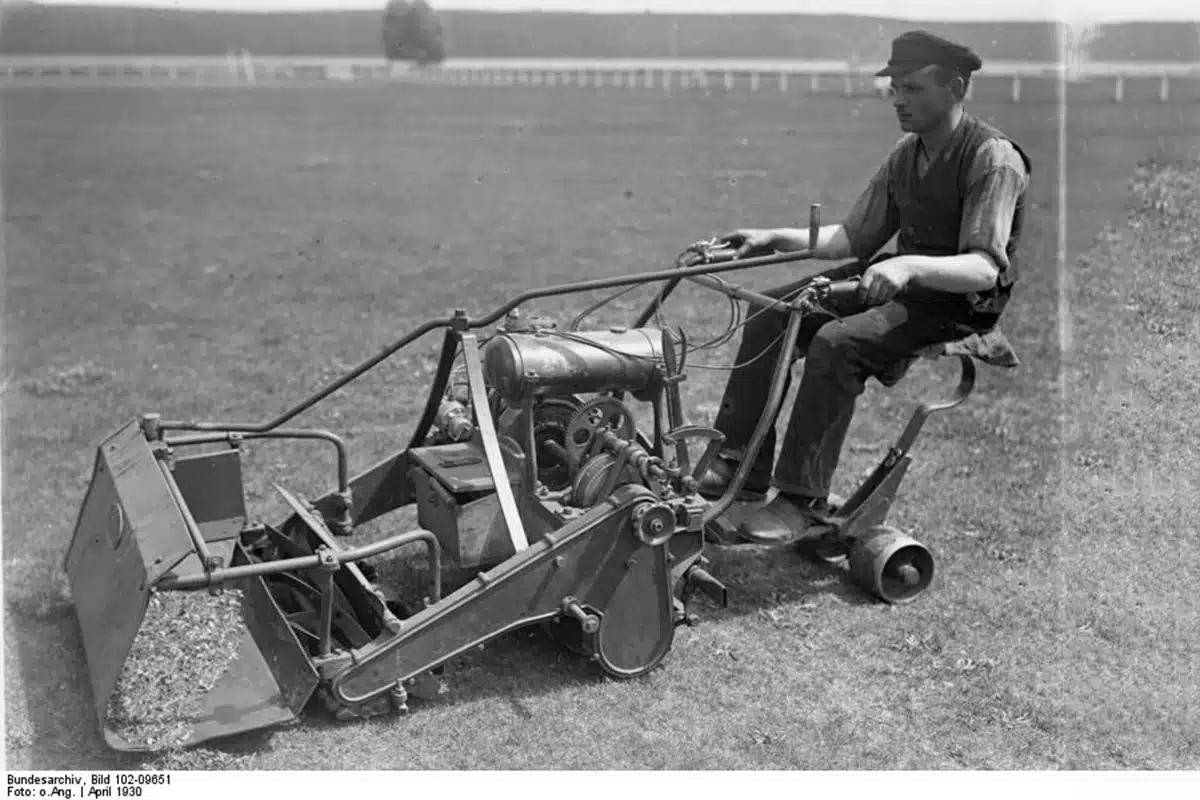
A black-and-white photo of a man, wearing a vest and cap, sitting on a large, mechanical mower
As this photo from 1930 shows, riding mowers have been around a long time.

Since then, mowing technology has come a long way, but just like Beard’s original invention, the majority of today’s mowers still require someone to drive or push them. But not for long.

Robotics Enter the Picture

The first robotic mower made its appearance the same year that Apollo 11 landed on the moon. In 1969, Spencer L. Bellinger, another intrepid engineer, created the first retail robotic lawnmower. Dubbed the MowBot, it operated through a signal wire that set the boundaries for operation. According to a New York Times article from that era, “. . . the mower [is] entirely safe and so quiet that it can be operated at night.” At the time, however, the MowBot was seen more as a whimsical gadget than a practical piece of landscaping equipment.

That started to change in the 1990s, when more advanced robotic lawnmowers made their debut. In 1995, Husqvarna developed a modern-style, solar-powered version of the self-driving machine. It featured several improvements over its predecessors, including enhanced programmability, smartphone control, and autonomous obstacle avoidance. This time, robotic lawnmowers were taken seriously, leading to further technology advancements. By 2005, robotic lawn mowers represented the second largest category of domestic robots.

Mower technology continues to develop at a fast pace, as more companies enter the market. According to the IBIS World Landscaping Service Industry Report, the landscape service industry is a $129 billion enterprise. Not surprisingly, many companies want to tap into this lucrative market, and they’re doing it with robotic mowers that offer a host of benefits for commercial landscape maintenance.

Because they run on batteries, self-driving mowers are quieter than their gas-powered, human-operated counterparts.

Addressing Labor Shortages in Commercial Landscape Maintenance

Approximately half of a company’s landscaping budget is spent on labor—assuming the company can find that labor. According to the 2021 Green Industry Benchmark Report, attracting and retaining employees is still the landscaping industry’s biggest problem, with 70% of landscapers reporting difficulties in finding employees. While a self-driving mower still requires some minimal human interface, it’s estimated that in many instances it can reduce labor costs by 90%.

The National Association of Workforce Boards—an organization that connects workforce professionals with Washington, D.C. policymakers—welcomes these advances. “We are embracing technology more than ever, with no fear of worker displacement. Autonomous mowers keep the turf maintained, freeing up workers to focus on more skilled tasks, such as pruning and plant diagnostics,” the association says on its website.

And saving on wages isn’t the only cost benefit of self-driving mowers. Scythe Robotics, which manufactures autonomous lawnmowers, claims the typical landscaper needs to replace a gas-powered mower every three to four years. Although self-driving mowers can be expensive up front, most are electric and so are more economical in the long run, due to longevity and reduced maintenance (no spark plugs, gas, or oil required). Scythe even offers a pay-per-acre model to its customers.

Other companies, like Graze Inc., function on a hardware/software model. The purchaser makes an initial investment in equipment, and then makes a monthly service payment for the software to keep the mower up to date and functioning. Graze claims an investment in one of their machines will increase a landscaping company’s profit margins by fivefold. Another seller of these autonomous machines, Turflynx, claims that switching from traditional to self-driving mowers reduces energy consumption by 80% and maintenance expenses by 40%.

The Eco-Friendly Solution for Commercial Landscape Maintenance

Electric self-driving mowers also have benefits for our planet. According to the U.S. Environmental Protection Agency (EPA), landscaping equipment engines produce up to five percent of our national air pollution. In fact, the California Air Resources Board reports that operating a commercial gas lawnmower for one hour emits as much pollution as driving a passenger car for about 300 miles. Statistics like this are motivating more companies to adopt electric self-driving mowers.

In general, companies today are searching for more sustainable approaches to facilities maintenance. Many have already turned to eco-friendly solutions for cleaning, so eco-friendly landscape maintenance is a logical next step. Fortunately, these businesses now have more practical choices in electric equipment, as battery technology has drastically improved over the past several years.

The Future of Commercial Landscape Maintenance

Adding convenience, cost savings, and other benefits to a company’s landscape maintenance routine doesn’t require sacrificing a beautiful exterior. While some businesses may be hesitant to use new technology such as autonomous mowers, others are embracing it.

In April 2022, the City of Glendale kicked off a pilot program with Graze, in which park staff will test and provide input on Graze’s automated electric mowing equipment. Glendale mayor Paula Devine promoted the partnership, saying, “Well, this is certainly an exciting day for the City of Glendale as we are the first—the very first—to partner with Graze.”

How quickly companies adopt self-driving mowers for their commercial landscaping and maintenance remains to be seen. But as autonomous mowers and battery-powered equipment roll out over the next decade, many expect that the majority of companies will start to embrace this cutting-edge technology. The benefits—lowered costs, increased sustainability—are just too significant to ignore.

A Facilities Management Partner You Can Rely On

No matter what technologies you prefer for your landscape maintenance, our award-winning service can help you maximize savings, manage resources, and plan for the future. Contact us today to learn more.

What is product lifecycle management? A marketing strategy, devised by economists decades ago? A storage solution for engineering data? Or a tool that optimizes product development?

The answer is all three. Product lifecycle management (PLM) can be defined as a strategic approach that encompasses all the processes, tools, and methodologies needed to manage the entire journey of a product—from its conceptualization to the end of its life.

From inception to end of life, for hardware and PCBA design, PLM tools can add value to your electronic product at each stage.

PLM’s strength in product development comes from streamlining and optimizing all data, operations, and activities associated with a product’s lifecycle. It involves cross-functional teams, departments, and even external partners. For manufacturing, product lifecycle methods enable companies to increase process efficiency, enhance innovation, and improve time to market.

Given the breadth of the strategy, does the value outweigh the effort—and what net results can be expected? We’ll help uncover what’s involved and how PLM can be key in creating successful electronic products.

The Evolution of Product Lifecycle Management

Theories behind product lifecycles have been around for decades. In the 1960s, economists posited four fundamental stages for a “product life cycle”: introduction, growth, maturity, and decline. These stages began as a sales and marketing concept, but today the theory is also used as the basis for product development across multiple industries.

As with many tales of industrial innovation from the latter part of the 20th century, the evolution of PLM from a 1960s concept into a framework for streamlining manufacturing tracks with the rise of technology and computers. PLM’s journey started when electronic design came off the page and onto the computer screen with computer-aided design (CAD) and the subsequent need to manage and store engineering data.

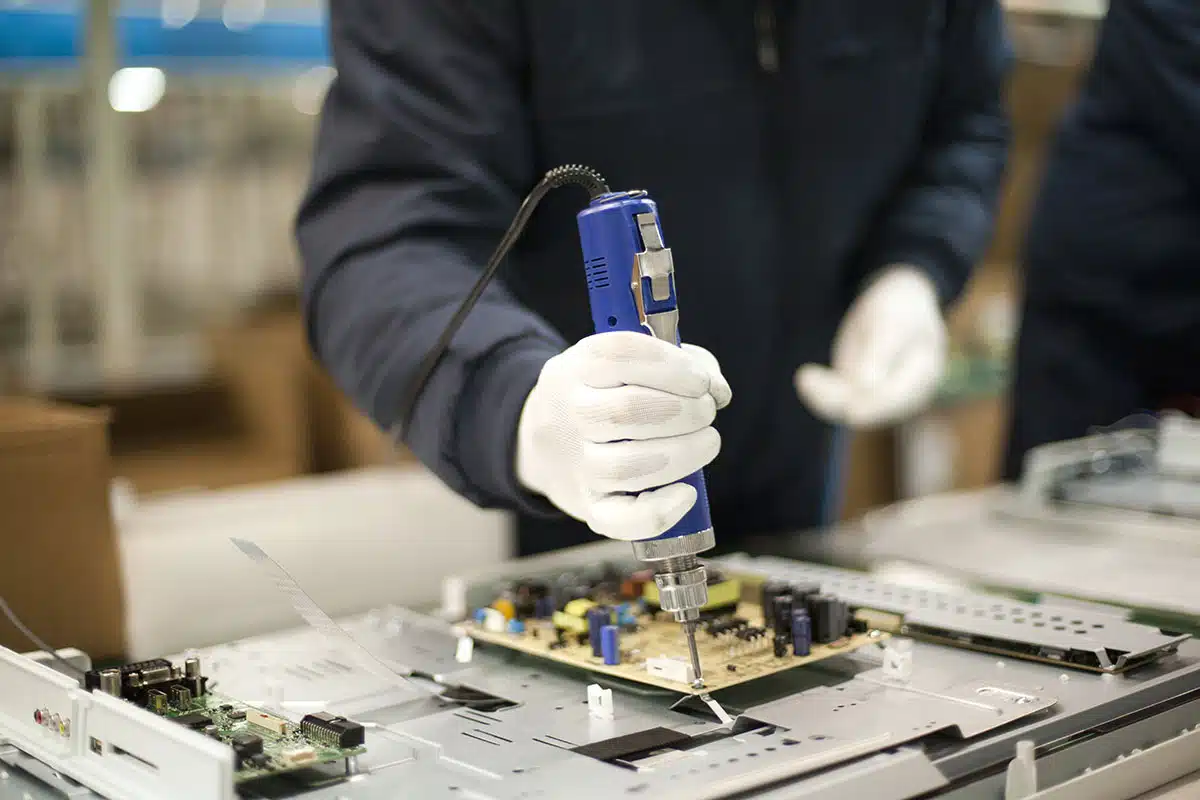
A closeup of a technician in an electronics factory, wearing latex gloves, using an electric screwdriver to attach a PCBA to a product’s shell
An important part of PLM is streamlining your production processes.

Things really took off in 1985, when automaker American Motors Company (AMC) was looking to speed up the product development process of its Jeep Grand Cherokee. To do this, the company started using CAD software and created a centralized database for the project. This centralized system enabled designers and engineers to quickly access data, which led to greater consistency and increased accuracy. This innovation was a huge success and a pioneering move toward modern product lifecycle management.

Fast forward to today, when an increased ability to store digital information and advances in processing technology have ramped up PLM’s ability to offer a holistic framework for product development that results in efficient resource allocation and reduced time to market. It’s these overwhelming benefits that led to the adoption of PLM principles across multiple industries—including electronics manufacturing.

Product Lifecycle Management Success in Electronics Manufacturing

Utilizing PLM methodologies to manage the entire journey of a product clearly benefited the auto industry. But how does this translate to the complicated and ever-changing landscape of electronics? After all, electronics manufacturing is a sector that demands cutting-edge and high-quality products that must be delivered within short timeframes to satisfy customer needs and fickle consumer tastes.

In the complex and data-dense electronics manufacturing arena, the most powerful way to harness PLM has to be through a degree of digital transformation. While product lifecycle management is essentially a strategy, the most effective implementation of that strategy will come from a cloud-based system that integrates Enterprise Resource Planning (ERP) and Supply Chain Management (SCM) systems and leverages the capabilities of emerging technologies such as artificial intelligence (AI), the industrial internet of things (IIoT), and virtual reality (VR).

These technologies have infiltrated nearly all aspects of business. In fact, a recent report by Deloitte confirmed for a second year in a row that across industries, companies with greater digital maturity are three times more likely to report higher-than-average net profits and net revenue growth, when compared to organizations with low digital maturity.

Luckily, greater digital maturity doesn’t have to reside entirely in-house and can come from partnering with experts. A professional electronic manufacturing service (EMS) whose engineers are well-versed in product lifecycle management for manufacturing and production can give you the technical edge you need.

From inception to end of life, for hardware and PCBA design, PLM tools can add value to your electronic product at each stage. Here are some of the ways.

Concept, Design, and Development

The beginning of an electronic product’s life—when designers are tossing around ideas and solutions for every aspect of a product’s function—is an exciting time. Effective product lifecycle management requires designers, engineers, and managers to work together at multiple stages of product development.

Innovative Product Design: Planning for a product’s entire lifecycle is a multidisciplinary effort, one that yields multiple benefits. For example, at the inception stage of an electronic product’s development, product lifecycle management fosters creativity and innovation by bringing cross-functional teams together. In breaking down silos, design development is accelerated, and ideas are transformed into tangible solutions.

Prototyping: PLM relies on digital prototyping, which allows engineers to explore multiple design iterations virtually. This reduces the need for costly physical prototypes, creating an efficient design process, and pushing innovative products to market faster.

Component Optimization and Management: Electronic components are the building blocks of every electronic device, and component selection is an art in itself, especially when planning for a product’s entire lifespan and eventual recycling. For this reason, component choice is a critical challenge of PLM. And here’s where access to detailed records of component specifications and availability, such as Last Time Buy (LTB) or End of Life (EOL), enables informed decisions on component selection. For an industry where components can become obsolete in the blink of an eye, this is an invaluable aid in predicting how design innovations can affect the longevity of a product.

Manufacturing and Production

The components you choose impact the longevity of your product’s lifecycle.

Production timing is vital in electronics manufacturing. Small delays can result in large holdups. Working with cloud-based PLM systems can mitigate potential problems and keep projects nimble by enabling several important functions.

Exception Management: Manufacturing electronic devices involves precision and intricate processes, so it’s inevitable that during operations some problems will arise. Product lifecycle management is an excellent tool for exception management with a unique ability to address deviations quickly and systematically. Time is money in production runs, so minimizing production bottlenecks and streamlining throughput can be a lifesaver.

Impact Assessment: Product lifecycle management tools also provide the means for assessing the impact of component scarcity on production schedules. When datasets are easily accessible and visible, engineers can evaluate the severity of production hiccups, whether it’s a short-term supply issue or long-term unavailability of a crucial input.

Agile Response to Challenges: In traditional manufacturing scenarios, the long-term unavailability of a critical component would lead to production halts and perhaps even a premature end to the product. PLM solutions, however, take a more agile approach. Component changes to the bill of materials (BOM) are quickly relayed to procurement departments, and costs and lead times are rapidly reassessed. This flow of information allows for impact assessment and alternative solutions to be quickly implemented.

Controlled Change Management: PLM tools facilitate controlled change management by providing modifications to circuit designs that are updated in the manufacturing dataset and seamlessly introduced into production. These changes can be swiftly but thoroughly verified and incorporated into the manufacturing process within days, rather than the months that traditional approaches might require.

Maturity and Support

Product lifecycle management doesn’t end when the product reaches customers’ hands. Keeping customers satisfied requires ongoing effort. As an integrated system, PLM can manage how the product is faring in the marketplace.

Compliance and Supplier Collaboration: In the heavily regulated electronics manufacturing industry, compliance with industry regulations and standards is crucial. PLM systems keep a vigilant eye on compliance throughout the product lifecycle, keeping up with changes and reducing the risk of noncompliance and related penalties.

Product Support and Maintenance: In addition to conducting trend analysis to anticipate future support needs, product lifecycle management can manage support and maintenance issues. This proactive approach helps identify potential faults before they become widespread. Making product adjustments during production is a more cost-effective move than recalling and replacing products due to inherent design flaws—it can also result in substantial cost savings over the product’s lifespan.

Improvements and Consumer Feedback: By using product lifecycle management tools to manage and analyze consumer feedback, engineers can resolve any design issues and modify future production runs or product iterations. 

Supply Chain: With their links to supply chain management systems, PLM tools can manage supply chains while the product is on the market and in demand, ensuring consistency and reliability.

Sustainability and End of Life

Making electronics as sustainable as possible is an ongoing and evolving task. PLM systems’ planning abilities can ensure that planet-friendly options for their products are considered.

Component Reuse: Customers want to know that products are as green as possible. PLM systems can identify opportunities for component reuse in electronic devices. This enables manufacturers to explore environmentally friendly options, extending the lifecycle of valuable components and materials and reducing electronic waste.

Responsible Disposal: In situations where reuse is not an option, PLM practices ensure compliance with recycling regulations and environmentally responsible disposal by systematically tracking and documenting product components and materials.

PLM Continues to Evolve

From cradle to grave, when used expertly, product lifecycle management systems can truly optimize a product. These systems can be used for nearly every aspect of product management—from gathering requirements, creating designs, and simulating product functionality, to streamlining manufacturing processes, tracking supply chains, and collecting data on performance.

PLM’s ability to do this comes, in part, from its origins as a strategy to enable companies to stay ahead of the curve. During the past few decades, PLM software has evolved from simple tools for managing product data to complex systems that can automate many aspects of the product development process. And as computing power continues to grow, PLM is sure to become an even more robust design and manufacturing tool for electronics companies.

An Electronics Manufacturing Partner You Can Rely On

Looking to improve your product development and production? Our engineers are SMTA-certified and expert in product lifecycle management. Contact us today to see how we can help you get the biggest return from your product design.