Our Stories

In October of 1775, the fledgling nation that would become the United States of America was in trouble. The British Navy—one of the strongest in the worldwas using its military superiority to disrupt trade in the rebellious colonies and attack seaside settlements. 


Something had to be done, or the American Revolution might fail almost as soon as it had begunIn response to the crisis, the Continental Congress formed a Marine Committee and charged its members to organize a navy. At the time, many colonists considered the project a fool’s errand. The colonies had no naval yards, no factories to produce artillery, and no hemp or sailcloth.


Nevertheless, on October 13, 1775, the Continental Congress voted to convert two sailing vessels into warships, arming them with carriage and swivel guns. And with this legislation, the nation’s navy was born. Over the next three years, the Continental Navy grew to include 50 armed ships of various types, some of them converted merchant vessels.


While the fleet was too small to take on the British navy’s full might, the Continental ships nevertheless played a key role in the Revolutionary War. They carried diplomats and correspondence to Europe, then returned with much-needed munitions. The American fleet also captured nearly 200 British vesselsdealing a serious blow to enemy morale and forcing the British to divert warships to guard key trade routes.  


Small but mighty, the Continental Navy did its part to help the colonies win the Revolutionary War. 

The New Steel Navy

After the Revolutionary War, the U.S. Navy was temporarily disbanded due to a lack of funds. For 12 years, beginning in 1785, the nation’s maritime duties were handled solely by the Revenue Marine, the forerunner of today’s Coast Guard. 


But in the 1790s, the growing conflict with Algerian pirates made it clear that the United States needed a full-fledged navy to protect its trade routes abroad. To combat this threat and others, Congress passed the Naval Armament Act in 1794, authorizing the construction of six frigates. The U.S. Navy was back. 


Over the next few years, the size of the Navy grew slowly. Nevertheless, this small fleet contributed greatly to America’s success in the Barbary Wars and the War of 1812. Even so, it would take a domestic conflict to push the Navy into an era of rapid change.  


The Civil War brought great technological changes to the U.S. Navy. Steam power replaced sails. The wooden hulls of existing ships were reinforced with armor platingwhile new ships were constructed entirely of iron or steelGuns increased in both size and range, and gained the ability to turn in any direction, which meant that ships could achieve more firepower with less weaponry. 


The Civil War also marked the first time that African-Americans served in the U.S. Navy in large numbers. During the war, 10,000 African-American men took on various duties, and seven of them earned the Medal of Honor.  


One such man was Robert Blake, who proved his mettle while serving on the gunboat USS Marblehead. Blake had been assigned the non–combat role of steward. But when the Marblehead was hit by enemy fire, killing the man who loaded the rifle guns, Blake took over, running much–needed gunpowder to the guns, and enabling the Marblehead to return fire. His actions were later described as both “cool and brave” by the ship’s commander.


After the conclusion of the Civil War, the U.S. Navy entered another period of slow growth. But before long, it became clear to government leaders that if America were to take its place on the world stage, it would need a world-class navy. So in the 1880s, the U.S. began modernizing its naval forces. It launched the nation’s first steel warships—protected cruisers with names like Atlanta, Boston, and Chicago. Armored battleships soon followed. And then the US debuted a truly revolutionary technology: the submarine.

Under the Sea: The Birth of the Submarine

The world’s first combat submarine was invented and used briefly during the Revolutionary War. Called the Turtle, this craft met all the criteria of a submarine; it could submerge, maneuver underwater, and carry oxygen for its occupant. But the Turtle bore little resemblance to modern craft. It looked instead like a giant wooden beer barrel. It could carry only one person, and was hard to maneuver. Nevertheless, it proved that submersible technology was viable. 


The U.S. Navy acquired its first official submarine in 1900. The USS Holland was nothing like the Turtle. Made of steel, able to accommodate a crew of six and dive 75 feet below the surface, the Holland looked much like today’s modern submarines, in shape if not in size. The Holland also introduced several key technologies: ballast and trim tanks to enable precise underwater maneuvers, torpedo tubes, and two pneumatic dynamite guns. The ship also had a gasoline engine for surface operations, and an electric motor for use when submerged.


The Holland was the first in an unbroken line of U.S. Navy submarines. The craft continued to get bigger and more sophisticated over the years, and the number of subs in the Navy fleet expanded. By the time World War I began, the Navy was able to deploy 72 submarines throughout the world.


But it wasn’t until the Second World War that submarines became a staple of naval operations. World War II was the first conflict in which submarine power played a decisive role, especially in the Pacific theater. Compared to their World War I ancestors, the submarines of the 1940s were bigger, stronger, and better equipped—both with more firepower and new technologies like sonar. During World War II, U.S. submarines destroyed more than 1,300 warships in the Pacific. Navy submarines also delivered troops for special missions, and rescued downed carrier pilots, including future President George H. W. Bush.

Help on the High Seas

Today, the U.S. Navy has more than 70 submarines in service within its fleet of nearly 450 ships. And while all the ships in the fleet are designed for defense, the U.S. Navy also has a long record of providing humanitarian aid, rescue services, and emergency medical assistance. Like all branches of the military, the Navy is often called upon to help in times of crisis, whether domestically or abroad. 


Since the 1950s, Navy personnel have actively participated in disaster relief efforts throughout the world. They’ve mounted rescue operations after flooding in Kansas and Spain. They’ve brought in food and supplies after earthquakes in Alaska and Greece, and done the same after hurricanes in Texas and Haiti. They’ve also helped fight fires in California and Japan.


Navy personnel have rescued crews and helped damaged ships all over the world. In 1961, for example, the Navy rescued 84 seamen from two commercial ships stranded in the Pacific. And over the past few decades, the Navy has performed dozens of similar rescues, saving the lives of both seasoned crewmen and novice sightseers.


Dozens of countries and thousands of people have benefitted from the aid provided by the U.S. Navy.

PRIDE Welcomes Navy Veterans

Navy personnel’s training in service makes them sought-after employees once they return to civilian life. PRIDE Industries is fortunate to employ many Navy veterans and dozens of veterans from other branches of the military.


To seek out these highly valued employees, PRIDE developed the Military Skills Translatoran online tool designed specifically for veterans. With the Skills Translator, military veterans can easily determine which civilian jobs best correspond to the valuable experience they gained while serving our country.


To paraphrase Admiral George Anderson: Navy veterans have both a tradition and a future. PRIDE Industries is pleased to be part of that future for so many veterans.
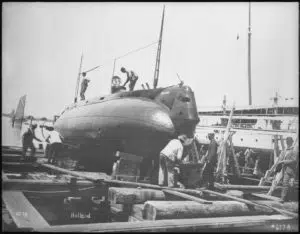
USS Holland
The USS Holland under construction in 1900

For over 50 years, PRIDE has witnessed firsthand the benefits of a diverse workforce encompassing employees of all abilities. Ray Muro is one such outstanding employee. Ray has worked at the U.S. Army Post Fort Bliss in El Paso, Texas since 2007, where he is an important asset in the Self-Help warehouse.

Before joining PRIDE, Ray earned an Associate degree in Human Services and Liberal Arts and a Bachelor’s degree in Multi-Disciplinary Studies from the University of Texas, El Paso. Despite his qualifications and enthusiasm, Ray could not find a permanent job due to misconceptions about his disabilities.

Ray was born with Retinopathy of Prematurity (ROP), an eye disease common in premature babies. It causes abnormal blood vessels to grow in the retina and can lead to blindness, as it did with Ray, who has been blind since childhood. Working-age adults with significant vision loss have a 30% employment rate.

Hired as a Stock Clerk in the Self-Help shop, Ray manages the inventory of parts such as paint or batteries, registers customers into the database, and categorizes new supplies. To master his position and make it easier for him to navigate the shop, Ray spent two weeks labeling everything with braille stickers to serve customers faster.

“When I attended college, I didn’t have access to braille books, so I had to use speech technology or a reader,” said Ray. “But braille often works better. It’s such a powerful tool to help people who are blind navigate the visual world.”

Ray is an expert in the shop; he has the entire layout and inventory memorized. He knows all the stock numbers by heart and types them into a braille notetaker to track distribution and verify inventory during cycle counts. Another innovative technology, a computer screen reader that provides speech and Braille output for computers, lets him access all the applications he needs to do his job well.

“When I first joined PRIDE, I was impressed with how quickly Ray was able to find and retrieve items,” said Lorena Ramos, Warehouse Supervisor. “He recognizes every customer that walks in, and we always receive feedback for his friendly attitude and excellent work.”

Attention Employers

Need help hiring talented and motivated people with disabilities at your company?

October 2020 marks the 75th anniversary of National Disability Employment Awareness Month (NDEAM). Established by the Department of Labor in 1945, NDEAM celebrates America’s workers with disabilities and reminds employers of the importance of inclusive hiring practices.


This year’s NDEAM is especially significant, as 2020 also marks 30 years since the passage of the Americans with Disabilities Act (ADA). This act prohibited discrimination based on disability, including in the area of employment. It also mandated reasonable accommodations and accessibility for people with disabilities.


In recognition of the ADA’s 30th anniversary, this year’s NDEAM theme is “Increasing Access and Opportunity.” That’s a goal that PRIDE embraces heartily, as it has been part of our mission for more than 50 years.

A Mission of Inclusivity, A History of Success

PRIDE Industries was founded in 1966 as a nonprofit with a straightforward mission: to create jobs for people with disabilities. Since its beginning, PRIDE has adhered to this singular goal, but the paths we’ve taken to carry out our mission have evolved over the years.


When few businesses would hire people with disabilities, PRIDE’s founders decided to create the jobs themselves, making PRIDE a rare entity at the time. Years later, in the early 1980s, PRIDE began selling services to other companies, thus transitioning to a nonprofit social enterprise. We are one of the earliest organizations to demonstrate how effective the social enterprise model can be.


One of the first services offered by PRIDE was kitting and fulfillment. This business line is still important to the company, employing hundreds of people with disabilities, but it is no longer the only service we offer. Today, our employees work in various fields across the country, manufacturing medical devices, maintaining buildings, managing inventory, performing sustainable environmental and custodial services, and providing technical support.


As a nonprofit social enterprise, 100% of PRIDE’s revenue directly supports our mission, allowing us to provide employment services to even more people across the nation. The money earned by our lines of business serves two purposes. It enables us to pay desirable wages and maintain PRIDE’s infrastructure, and it funds our network of support programs for people with disabilities. Today PRIDE employs more than 5,600 people, including more than 3,300 people with disabilities, making us the country’s leading nonprofit employer of people with disabilities.


PRIDE offers a wide range of services to help people who face employment barriers, a population that includes service-injured veterans and former foster youth. We provide job training, employee recruitment, and on-the-job coaching for people of all skill levels. And our personalized approach means that everyone who joins us benefits from a program designed to maximize their success.

A New Path: PRIDE Introduces Inclusive Talent Solutions

At PRIDE, we’ve long known that employees with disabilities can be highly productive. And our employees—through their hard work and dedication—have proven this to our many customers.


But perhaps the biggest proof of our success is the number of companies now seeking our expertise to develop a more inclusive workforce. They’ve realized that employees with diverse abilities make many valuable contributions, and they’ve seen the studies showing that employees with disabilities have high retention rates, low absenteeism, and a positive effect on workplace culture.


But while many companies are now interested in the advantages conferred by an inclusive workforce, few know how to create and maintain a diverse employee base. They lack the workforce planning expertise, internal training tools, or regulatory knowledge needed to work with a diverse population. Because of this, some companies are hesitant to pursue the goal of an inclusive workforce, despite its many advantages.


In keeping with our mission, PRIDE created a new service to help these companies. Inclusive Talent Solutions (ITS) recruits, trains, and provides ongoing coaching for people with disabilities at our partner companies. Our goal is to make it easy for businesses to create an inclusive workforce and decrease the barriers to employment faced by people with disabilities.


ITS represents a new path for PRIDE. It’s yet another way for us to fulfill our mission to support even more people with disabilities. That’s why we’ve chosen to launch this new service in conjunction with the 75th anniversary of the NDEAM. The NDEAM is a celebration of the many contributions made by people with disabilities in the workplace. PRIDE is pleased to be able to help more companies benefit from these contributions.

On September 18, 2020, the U.S. Air Force celebrates 73 years of service, but its origins stretch back much further.


The USAF was officially formed in 1947, after World War II made it clear that the skies were a significant theater for military operations. But the foundation of the Air Force had been laid forty years earlier, in 1907, when the U.S. Army Signal Corps established an Aeronautical Division. Only four years had passed since the Wright Brothers had taken their famous flight at Kitty Hawk, North Carolina, but already it was clear that airplane technology would play a role in national security.


The Aeronautical Division was the world’s first heavier-than-air military aviation organization. It pioneered many of the systems and protocols that aviation organizations rely on today, including formal training for pilots and a rating system for pilot qualifications.


During World War I, the Aviation Section (which had replaced the Aeronautical Division in 1914), organized the country’s first aero squadrons and conducted the first U.S. military aviation operations on foreign soil. These squadrons were vital in the fight against enemy aircraft along the Western Front during the first world war.


Air squadrons proved their usefulness in World War I, but it was the second world war that made clear how crucial an air force was to national defense. During World War II, battles were fought just as readily in the air as they were on land and at sea. The skies had become a full-fledged theater of war. And to meet this threat, the U.S. expanded its aerial forces. At the height of WWII, the U.S. Army Air Force (as it was still called then) had more than 2.4 million men and women in service and nearly 80,000 aircraft. It also had nearly 800 domestic bases and operated 1,600 airfields worldwide.


As these numbers show, by 1947 the Air Force had grown into a full-fledged branch of the military, on par with the Army, the Navy, and other military branches. Its official designation as a separate military branch on September 18 of that year was a recognition of this fact.

The Air Force Today

Today the United States Air Force (USAF) is the second-largest service branch, with 320,000 active-duty airmen, 146,000 civilian personnel, 69,000 reserve airmen, and 106,000 Air National Guard airmen.


Likewise, the USAF has expanded its operations since its early days. Today’s Air Force not only conducts its own independent air operations, but also coordinates with other branches of the military to provide air support for their missions. And in addition to playing an active role in every major conflict since its inception, the USAF has been an important factor in U.S. humanitarian relief efforts.

Top photo: An Air Force F-35A Lightning II Joint Strike Fighter

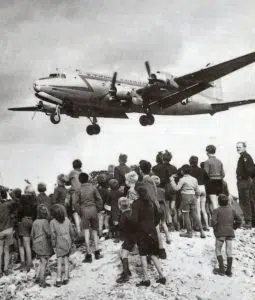
One of the service’s earliest humanitarian missions took place in 1949, when the Air Force dropped 1.8 million tons of food and supplies during the Berlin Airlift, thus ensuring the continued existence of democratic West Germany. Since then, the scope of the Air Force’s humanitarian missions has broadened considerably, and includes medical, rescue, and other types of aid.


Today, the USAF regularly provides emergency medical care with its Critical Care Air Transport (CCAT) Team. The service operates several C-130 aircraft that have been fitted to operate as flying ambulances. A different set of C-130s—equipped with the latest firefighting technology—are called into action to serve as air tankers during large wildfires.


A few of the service’s humanitarian aid programs have evolved into annual traditions. In Guam and Japan, for example, Operation Christmas Drop has taken place every year since 1952. As part of this operation, airmen stationed in those locales deliver much-needed supplies to the nearby Micronesian islands. (Fun fact: These supplies often include toys and soccer balls.)


When a natural disaster strikes somewhere in the world, there’s a good chance that USAF personnel will be there to help out. This was the case when a 7.0M earthquake struck Haiti in 2010. As part of Operation Unified Response, the USAF joined other branches of the military in providing aid to the small nation. The Air Force delivered 19 million pounds of cargo, evacuated thousands of American citizens, and conducted aeromedical evacuations for 223 critically injured Haitian patients.


After the earthquake struck, more than 6,000 USAF personnel arrived to help with rescue and other operations, performing a wide range of duties. At the damaged Port-au-Prince airport, for example, a small group of Air Force personnel—led by Chief Master Sergeant Antonio Travis–used handheld radios and a card table to direct the takeoff and landing of relief planes every five minutes. Thanks to this team, 150,000 bottles of water and 75,000 packaged meals were delivered to thousands of displaced persons.


The United States Air Force has come a long way since its beginning as part of the U.S. Army Signal Corps, so much so that it has itself become the progenitor of a new branch of the military. The Air Force Space Command, established in 1982, was the forerunner of today’s United States Space Force, which was designated the eighth uniformed service on December 20, 2019.


The Air Force has changed a great deal over the past few decades, with expanded operations and additional responsibilities. No doubt the next few decades will bring even greater changes. But no matter what the future holds, the Air Force mission will surely remain what it has been since 1947: to fly, fight, and win.

PRIDE Welcomes Air Force Veterans

As with other military personnel, the training that Air Force members receive while in service makes them valuable employees once they return to civilian life. PRIDE Industries is fortunate to employ many Air Force veterans, along with dozens of veterans from other branches of the military.


To seek out these highly valued employees, PRIDE developed the Military Skills Translator, an online tool designed specifically for veterans. With the Skills Translator, veterans can easily determine which civilian jobs best correspond to the valuable experience they gained while serving our country. The Military Skills Translator has enabled PRIDE to find meaningful employment for dozens of veterans from all branches of the military.


While working at any civilian company requires a transition from military life, many of the veterans now employed by PRIDE have said that it was the company’s worthwhile mission that first appealed to them. One such person is Jack Jackman, Vice President of Contracts and a retired Lieutenant Colonel.


“During my career with the Air Force, I sought ways to support local communities, wherever I was stationed,” said Jackman. “PRIDE lets me continue that tradition.”

Aircraft landing
Berliners await the arrival of an Air Force supply plane, 1948

The key to any successful workplace is open and efficient communication. Perhaps no one knows this better than Job Coach and ASL Translator Christina Alderete, who provides interpreting services for PRIDE Industries. Christina is an El Paso, TX native who works at PRIDE’s Fort Bliss contract. There, she delivers crucial communication to employees with her trilingual abilities in English, Spanish, and ASL. 


“In a border town like El Paso, TX, one is bound to be multicultural at heart,” Christina said. “Growing up bilingual in English and Spanish, I became a translator at an early age for my father and grandparents.”

Years later, the need for trilingual ASL interpreting services in the Hispanic Deaf population was growing. With this in mind, a friend encouraged Christina to learn ASL. So that’s exactly what she did.    


“In my ASL interpreter preparation program, you were highly encouraged to engage with the Deaf community, as you learn how Deaf people perceive signs and actions,” she said. “I became acquainted with the ‘Planet EYEth,’ a term the Deaf community sometimes uses to refer to themselves because they use their eyes instead of ears. This experience inspired me, and after graduating in 2014, I joined PRIDE Industries at Fort Bliss as a job coach and ASL translator.”

Providing ASL Services to Improve Employee Communication

Christina’s desire to bridge the communication gap in the Deaf community coincided with PRIDE’s goal to make every workplace more accessible and inclusive through ASL interpreting services and a wide range of other employment resources.


For example, many employees at PRIDE who are deaf or hard of hearing hold positions in technical departments, including electrical, HVAC, and plumbing. However, there are many industry specific terms and signs associated with these kinds of skilled trades. To streamline the training process and improve communication for everyone, the PRIDE Vocational Rehabilitation team consulted with employees. Together, they developed a work manual in English, Spanish, and ASL.


I truly enjoy using my trilingual abilities and feel privileged to assist both Deaf and hearing employees with interpretation services,” said Christina. “The deaf community at Fort Bliss has been very encouraging and provides excellent feedback to help me become a better interpreter.”  


Day to day, Christina enjoys the different ways she applies her ASL interpreting services for each employee. “The most powerful lesson that I have learned as an interpreter is that everyone is different; not all individuals sign the same. Some individuals are highly visual and lack literacy skills in English, so I help them develop strategies to work around that. During my six years at PRIDE, my greatest accomplishment has been observing the progress of the employees I have coached and seeing them succeed in their careers.”

Are you an employee in need of ASL services?

Find out how PRIDE Industries can help you bridge the communication gap at any stage of your employment journey.

“The most powerful lesson that I have learned as an interpreter is that everyone is different; not all individuals sign the same.”

It can be difficult for people who are deaf or hard of hearing to find jobs where they feel confident and understood. This is something PRIDE employee Rogelio Ibañez understands firsthand. In recognition of Deaf Awareness Month, he has shared his story with us. In his story, he also offers insight on how to communicate with those who are deaf or use sign language.

At Ft. Bliss, TX, many PRIDE employees are multilingual in both spoken and sign languages. This includes Rogelio Ibañez, who joined the team in 2011 and has continued to thrive in his job at Ft. Bliss, earning a promotion to General Maintenance Worker in 2015.

Helping Deaf People Find Jobs where Communication Isn’t a Barrier

Rogelio can communicate in four different languages: LSM (Lengua de Señas Mexicana), Spanish, ASL (American Sign Language), and English. His journey was one of perseverance.  

“I was born in Mexico to hearing parents and had three older hearing siblings and a younger one who was also Deaf,” he said. “My family initially didn’t know any sign language but communicated with me through gestures and lip-reading. When I moved to a mainstream school, they did not have an interpreter, so I learned both LSM and Spanish (both different languages in verb inflections, structure, and word order). One of my older siblings also learned LSM to serve as our family interpreter for school, church, and doctor visits.

“When I moved to the United States as a teenager, communication was an issue, as I only knew Spanish and LSM. I distinctly remember one time that the police stopped me, and I couldn’t talk to them because they didn’t know Spanish or LSM. Eventually, I met my girlfriend (who would eventually become my wife), and she taught me ASL and English, while I taught her LSM and Spanish. I began to attend Deaf coffee socials in Dallas to meet more people in the Deaf community and improve on ASL. English, however, is still something I am continuing to perfect.”

Rogelio faced communication challenges as he searched for work, but then he found PRIDE. In an effort to build an inclusive environment, PRIDE’s job coaches, ASL interpreters, and rehabilitation counselors translate between team members and customers, helping bridge the gap for employees who are deaf or hard of hearing. Assistive technology methods are also used to help employees overcome communication obstacles in their day to day jobs. This atmosphere of inclusivity and access was a true game-changer for Rogelio. 

Preparing Others in the Deaf Community for Job Success

In his spare time Rogelio helps teach a course at El Paso Community College where he  teaches basic signs in LSM and ASL to American students as well as Deaf students from Ciudad Juárez, Mexico. 

“It’s such an enjoyable experience to help connect with others who are looking to join this community,” he said. “We all share our goals and obstacles in a supportive environment.”

Rogelio offers advice for hearing people looking to improve their communication with those who are deaf, hard of hearing, or use sign language. “Utilize hand gestures or facial expressions. Of course, it depends on the individual’s preference; deaf and hard-of-hearing is not the same thing, and everyone has their own style based on how much they can hear.

Many Deaf people, including myself, rely on reading lips. During the COVID-19 pandemic, masks have sometimes been an obstacle, but wearing clear ones can help. Another option is to stand more than six feet apart so we can speak without covering our faces.”

Overcome barriers to achieve goals

PRIDE Industries offers a variety of employment services.
PRIDE employee Rogelio Ibañez

“In former positions, I felt out of place and became frustrated. Joining PRIDE Industries made a difference, as now I am comfortable with the work and can easily speak to my team”.