Supply Chain and Logistics

Supply Chain Automation and IoT

When it comes to supply chain solutions, “automation” continues to be the buzzword—specifically, smart automation through the Internet of Things. IoT, as the term is acronymized, makes use of sensors and beacons that, via the internet, connect to various monitoring devices. This technology, as we know it today, really gained traction around 2008 when the first IoT conference was held in Switzerland. Since then, IoT has spread across industries, including the supply chain.

From the back office to the warehouse, from transportation to delivery, fewer and fewer human hands are involved. But while some operations are large enough to benefit from full-on smart supply chain automation, smaller operations wouldn’t see a large enough ROI to justify a complete overhaul. For the majority of businesses, in fact, a hybrid model—in which some elements are automated and some are not—makes the most sense. 

“It may not always make sense to automate the entire supply chain,” says Bob Anderson, Business Development Executive for PRIDE Industries, “To get the most from automation, the end-to-end process needs to be evaluated for the best opportunities for cost savings and velocity.” 

According to Anderson, three areas benefit the most from automation: the warehouse, transportation logistics, and the back office. 

“Microsoft's 2019 Manufacturing Report showed the average cost of an IoT sensor fell from around $1.30 in 2004 to a projeced cost of $0.38 in 2020.”

Supply Chain Automation in the Warehouse

Visibility into all links of the supply chain is critical. Starting with inventory management, an organization needs to know how much product is in stock, where it is, and in what condition. This is an area where IoT can make a significant contribution. In the warehouse, not only does this technology provide real-time data on a product’s shelf location, but it can also monitor temperature, humidity, levels of powder and liquid, and changes in the product’s general condition. These capabilities save time and labor that employees would otherwise spend in manual inspection and location. What’s more, extracted IoT data allows warehouse operations managers to discern trends and forecast future customer needs. 

But the reach of supply chain automation doesn’t just apply to products. It can also monitor equipment and machines. Used this way, the technology’s algorithmic predictions can greatly enhance preventative maintenance—whether in a robotic pick-and-place device or an ordinary forklift. Safety data can be easily harvested as well, allowing warehouse managers to discern what activities generate the most risk—as well as where, when, and how. By placing sensors on dangerous machinery, in problematic areas of a warehouse, and even on employee uniforms, facilities managers can monitor risky situations, thus improving safety in the facility.

The decreasing cost of sensors makes IoT more attractive to companies of all sizes. Citing data from Goldman Sachs, Microsoft’s 2019 Manufacturing Report showed the average cost of an IoT sensor fell from around $1.30 in 2004 to a projected cost of $0.38 in 2020. Of course, sensors alone are useless without an IoT infrastructure—devices, applications, data storage, support, and connectivity. And that’s where things can get pricey, which is why—for a smaller organization—simple RF scanners and bar codes may be enough.

Here, evaluation is key. Which specific aspects of your warehouse operation would most benefit from automation? It could be as simple as knowing the evaporation rate of a stored liquid or the condition of your most relied-upon machine. Or, maybe, all you need to know is how many widgets you shipped last month.

“By the end of the year, [Walmart] projects that this delivery mode could deliver over 1 million packages to 4 million U.S. households across six states.”

Shipping and Transportation Automation

Supply chain visibility also means that a supplier knows when its shipments are sent, when and where they are in transit, when the customer receives them, and in what condition. And here’s where a relatively new IoT technology, known as Multi-Dimensional Monitoring (MDM), can bring real benefits. MDM is capable of real-time tracking that generates notifications for all stakeholders along the supply chain. Plus, as an IoT platform, it can extract and interpret large volumes of predictive data. As with other IoT applications, this information depends on the type and location of sensors, as well as a company’s associated software and device choices.

According to an article featured on Flexis’s blog, Multi-Dimensional Monitoring allows suppliers to “get as granular as you need” when it comes to data.

You can be informed of any temperature and humidity fluctuations, alerting you if temperature surpasses a pre-defined threshold to ensure the quality of your cargo stays intact. Additional services include door opening and light intrusion notifications and shock detection, once again making you aware of any possible risks to the quality and condition of your products.

And shipping and transportation automation doesn’t stop there. Some companies have already begun using drones and autonomous vehicles. In fact, this May, Walmart announced that it will be expanding its DroneUp delivery network. By the end of the year, the big-box giant projects that this delivery mode could deliver over 1 million packages to 4 million U.S. households across six states.

Again, some organizations may need less specific transportation information than others. Delivery of toilet paper, for example, doesn’t require real-time temperature and humidity measurements. However, when store shelves are emptied of it, and customers are waiting, an IoT device that allows for tracking will certainly be beneficial.

Back Office Automation

Often the last in line when it comes to supply chain automation, the back office can nevertheless benefit greatly from IoT technology. That’s because, as stated in Supply Chain Brain’s blog, Supply-Chain Innovation: In the Front Office or Back? “ . . . the back office can have an outsized impact on the supply chain.”

Andy Stinnes, writing in Supply Chain Brain, notes that a company’s back office is where a “huge swath” of white collar employees can be found, “none of them touching, making, or moving any goods, yet engaged in a myriad of administrative support functions without which no supply chain could ever function.” Stinnes further notes:

They’re network planners, inventory managers, sourcing and procurement professionals, transportation analysts, trade compliance experts, and packaging designers—the list goes on. By some estimates, 15% to 20% of all employees in the supply chain are in the back office. Adjusting for generally higher salaries, that’s likely 25% or more . . . and that’s just labor cost.

Without the benefit of automation-generated data, everything from the design and placement of warehouses to the best transportation routes is subject to miscalculation, as are projected demands for goods, packaging requirements, and labor. Meanwhile, repetitive documentation, paperwork, and data entry tasks suck time, money, and labor away from higher-priority tasks.

New technologies, designed for the back office, allow for the streamlining and synthesis of time-consuming manual processes. Optical Character Recognition (OCR) programs, for instance, extract data from scanned documents, camera images, and PDF imagery, converting these data into words—eliminating the need for manual data entry. Data extraction and transformation also allow  for the automated generation of documents such as invoices, order forms, and contracts. Workload Automation Tools (WATs) and Robotic Process Automation (RPA) can automate workflows and carry out an array of repetitive computer tasks—from scheduling to order processing.

Within smaller organizations, back-office automation could be as simple as a robust CRM system, social media automation, a metric-providing email platform, and even a customer-interfacing chatbot—which can be implemented for as low as $15,000.

Supply Chain Automation is Here to Stay

Increasingly, even mom-and-pop businesses are seeing a need for some degree of supply chain automation. The good news is that IoT components can be pieced and woven together with elements that are not automated. While a large operation may go all out—upgrading its warehouse, shipping operations, and back office—a smaller company may find that only one key automation makes sense. So, for now, “it depends” may be the best answer to the question, “How do we get the most bang for our automation buck?”

One thing is certain. Automation is here to stay, and the ways to integrate it into the supply chain will only expand.

“As the importance of visibility and velocity within our supply chains continues to be tested,” says PRIDE Industries’ Bob Anderson, “automation will continue to be a real requirement at every stage in the process.”

“ . . . 15% to 20% of all employees in the supply chain are in the back office. Adjusting for generally higher salaries, that’s likely 25% or more . . . and that’s just labor cost.”

Ready to take your supply and logistics process to the next level?

Partner with PRIDE Industries to streamline your operations, drive customer satisfaction, and improve your bottom line.
cleaning in a hotel room

GDS expands its social mission and its business, with the help of PRIDE Industries.

Established in January of 2000, Granite Data Solutions (GDS) is a California Certified Disabled Veteran Owned Enterprise (DVBE) specializing in Client Lifecycle Management with a focus on serving state and local government entities, as well as education-related organizations.

Situation

Driven by the same mission to create job opportunities for veterans and people with disabilities, GDS partnered with PRIDE Industries for assembly and kitting in 2012. PRIDE Industries has since supported the business through its outgrowth of two buildings. Then, in 2018, when GDS expanded further and needed on-site packaging and shipping support, they turned again to a provider they knew they could count on.

Solution

After an evaluation, five work groups, composed of 15 employees with disabilities, were created to handle GDS’s IT-related deployment and depot-style service projects. For every work group hired by GDS, PRIDE Industries provided a work group trainer to help employees with developmental disabilities learn and succeed in their jobs.

With consulting help, GDS earned its Processed Food Registration (PFR) certification from the California Department of Health in October 2018. Instruction and training involved implementing safety, quality, and fulfillment guidelines—including proper food handling procedures, allergen separation, shipping, receiving, and lot code tracking. In addition, PRIDE Industries helped GDS develop its pricing and shop rate. Production lines, using lean manufacturing methods, were also created.

With GDS’s new food processing business plan implemented, work groups now help run up to four food-packing lines and handle shipping for four new customers.

Services Provided

  • Kitting and assembly
  • Pricing and shop rate development
  • Assistance in running up to four food packaging lines
  • Implementation of safety, quality, and fulfillment guidelines
  • Shipping, receiving, and lot code tracking
  • Creation of production lines using lean manufacturing methods

Results

  • Continued annual expansion
  • Processed Food Registration (PFR) certification
  • Four new business accounts acquired
  • Over 7,000 pallets per year
  • 24 truckloads per month
  • Expansion of mission of providing job assistance and training to people with disabilities.
  • Hiring of PRIDE Industries-trained individuals with developmental disabilities for its permanent staff
GDS logo

Highlights

15

individuals with developmental disabilities

8
years of business partnership
>7,000
pallets shipped per year
20
work groups of individuals with disabilities

“It’s been amazing to see what PRIDE Industries and GDS have been able to achieve in such a short amount of time. We’re excited to see what our partnership will bring in the future.”

Over the last two years, a growing  trend has multiplied, resulting in increased awareness for consumers, suppliers, investors, and those who facilitate the transfer of goods: Social responsibility.  Or, more broadly, environmental, social, and governance (ESG). And now, more than ever, the supply chain is factoring in—not only when it comes to satisfying consumer demand, but also regarding product returns.

Recently, the Reverse Logistics Association (RLA) explored this very topic in a webinar titled, “Why Using Nonprofits for Returns Management is Socially Responsible.” The webinar featured moderator, Tony Sciarrota, Executive Director and Publisher of RL Magazine, and three expert panelists: Claudia Freed, President and CEO of EALGreen; Travis Laws, President of WIN Warehouse; and Bob Anderson, Business Development Executive for PRIDE Industries. 

The discussion was one of depth and breadth; however, ESG dominated the conversation—notably transparency in the return process as well as re-use and environmentally ethical disposal of goods. Further underscored was an increasing shift in consumer awareness when it comes to requiring companies to be socially and environmentally responsible—an expectation that includes the entire supply chain. And to satisfy these expectations, companies are requiring their suppliers and transporters to have some kind of ESG framework in place.

“Almost every RFP or RFI that comes out now has some questions about what you do about sustainability,” said Bob Anderson of PRIDE Industries. “Also, what you do about people and your hiring practices.”

“Two-thirds of an organization’s ESG commitments lie with its suppliers”

A 2021 McKinsey report supports Anderson’s observation. Referencing this report, a recent Forbes article summarizes that “two-thirds of an organization’s ESG commitments lie with its suppliers.” The article further notes “. . . choosing the right supplier partners and managing them well is perhaps the most impactful decision for a company when it comes to sustainability.”

This is where nonprofits, when it comes to returns management—and supply chain, in general—shine. Because they are largely mission-driven, nonprofits typically already have a positive social or environmental focus built in. For example, both EAL Green and WIN Warehouse leverage used/donated materials—Green, to fund college scholarships and WIN, to help companies save on taxes while repurposing used materials. And PRIDE Industries? This social enterprise leverages its business services to create employment for people with disabilities.
Also built into each of these nonprofit’s business models is transparency.

In the webinar, Claudia Freed of EAL Green notes, “. . . transparency has now become an organizing principle . . . a nonprofit helps generate that value proposition.” She goes on to explain that, unlike a traditional corporation, a nonprofit must disclose its tax returns which, for example, reveal the highest-earning employees’ salaries. This requirement speaks to the “social” element of ESG, allowing stakeholders to discern the level of “pay equity” an organization cultivates.

When it comes to supply chain and reverse logistics, transparency is also achieved through traceability throughout a product’s lifecycle. Again, nonprofits are uniquely positioned to leverage their already-in-place transparency measures. For instance, because nonprofit donors want to know what their donations fund, nonprofits tend to be structured around allowing them to do this with relative ease.
“From a returns standpoint,” said Bob Anderson of PRIDE Industries, “we have a responsibility to show our customer where, when, and in what condition an item was received.” Anderson went on to say, “For example, if a company says to salvage part 1, 2, and 3, we act as a vehicle between them and the recycler—with transparency every step of the way. Plus, our customers get the added social impact of employing people with disabilities.”

Unfortunately, the benefits of using nonprofits for supply-chain needs aren’t yet on many companies’ radar. But the webinar’s panelists see that changing.

“I think the market is going to demand it,” said Travis Laws of WIN Warehouse. “Increasingly, consumers are going to want to know more and more. And we’ve seen that from younger generations.” Laws went on to note that the new generation of customers will, in time, be investors who carry their ESG awareness forward.

“The concept has evolved, from a charity that would go out with its hand” [out . . . to] “shaking hands . . . being a partner,” Freed, of ELAGreen, pointed out, underscoring the fact that nonprofits can, increasingly, offer the same business advantages to customers that traditional corporations do—while also offering tax breaks and a positive social impact.

“It’s a matter of awareness,” said Anderson, mentioning that a tech giant has relied on PRIDE Industries’ kitting and packaging services for 15 years—the kind of partnership many potential customers don’t yet associate with a nonprofit.

“It’s going to take time to change people’s mindsets,” continued Anderson. “And I’m confident that we will get there.”

Want to learn more?

The reverse logistics cycle is a key touchpoint for customers—a foundational process that provides opportunities to influence and improve customer loyalty. Find out how you can optimize the reverse supply chain to enhance the customer experience.

“. . . choosing the right supplier partners and managing them well is perhaps the most impactful decision for a company when it comes to sustainability.”

As the pandemic raged and basic goods went missing from our favorite stores’ shelves, the supply chain links involved in getting a product from point A to point Z were illuminated. And, turns out, one of the most imperative is truck transportation. Yet, given the job’s demands and workforce demographics, the trucking industry was already experiencing a decline in drivers. The pandemic compounded this trend, while creating a marked increase in e-commerce and home-delivered goods. As a result, the last two years have seen companies lose even more long-haul truckers. But one big-box giant is changing that.

This April, Walmart raised salaries for first-year truckers to between $95,000 and $110,000 annually.

The average American trucker’s salary is about $56,491. Walmart, already known for paying its truckers better than average, is nearly doubling that. But will other large retailers follow suit? Moreover, is the importance of a well-linked supply chain changing the way companies think—not only about truckers, but about all employees involved in getting goods from the manufacturer to seller to end-user?

Wage increases, across the supply-chain employee spectrum, suggest the answer is “yes.”

According to Material Handling & Logistics News, 59 percent of supply chain workers received a salary increase during the pandemic. And the trend isn’t limited to the U.S.

In Britain, for example, a recent survey shows that truckers and dock workers have become more appreciated by the general public than teachers or the police. Commenting on the survey’s results, Tim Morris, Chief Executive of the UK Major Ports Group, said, “More of the public have also woken up to the complex, sophisticated supply chains that deliver our just-in-time lives and businesses.” (Source: Financial Times)

And this appreciation isn’t just a matter of words. In 2021, British truck drivers’ salaries rose—some by as much as 40 percent overnight, according to a BBC article.


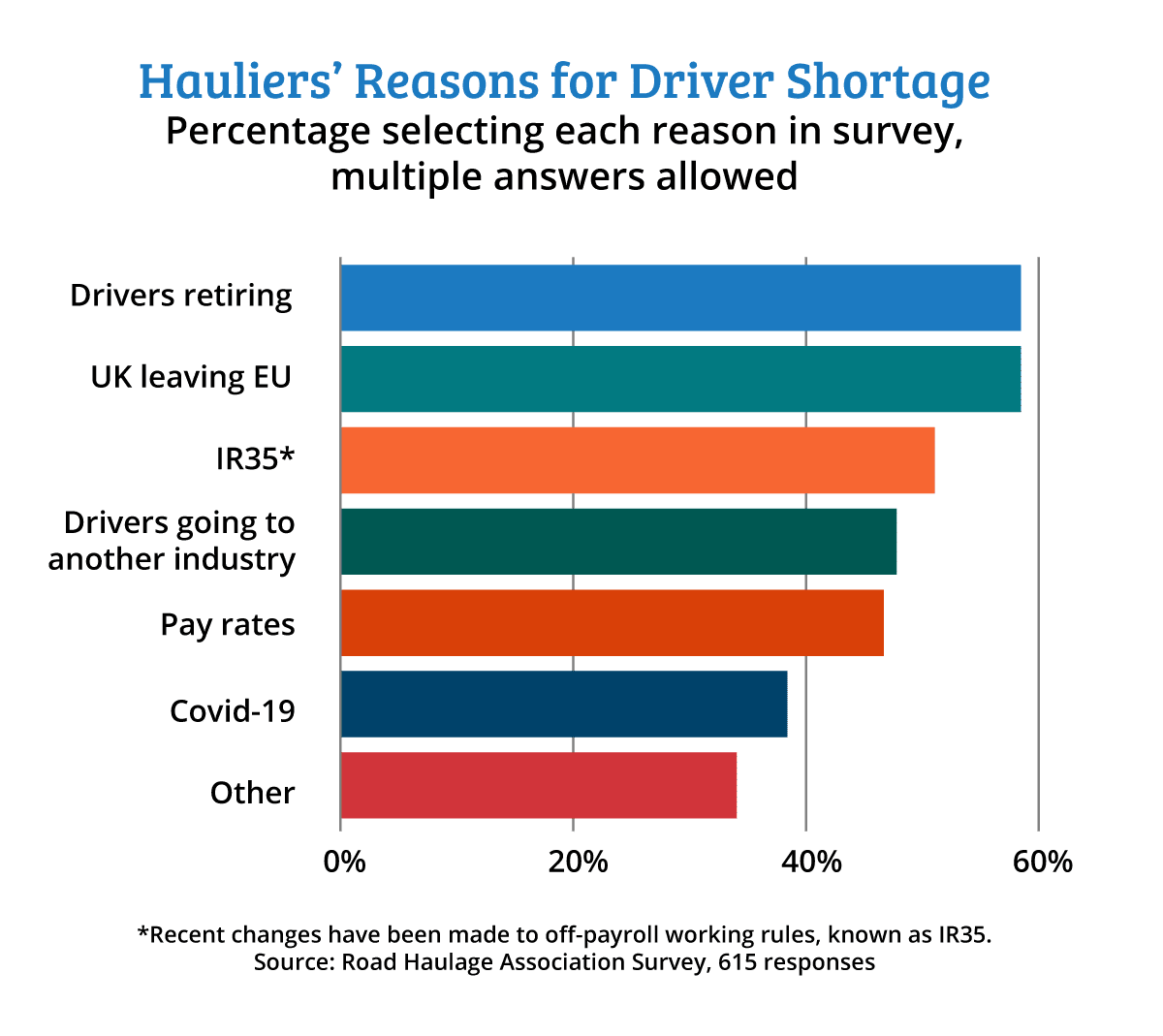
While Brexit has factored into the loss of truckers in the U.K., other reasons cited match those here in the U.S., including an aging workforce entering retirement, relatively low wages, workers pivoting to less-grueling industries, and COVID-19-related concerns—all in addition to the exhausting nature of the job, itself.

Back in the U.S., supply-chain staffing woes may get worse before they get better. For example, as West Coast union dock workers’ contracts move toward June expiration, the possibility of strike looms. Relatively well paid by standards typically attributed to “blue collar” jobs, longshore workers cite the dangers associated with their work and the huge profits made by the companies whose goods they move.

With both dock workers and truckers willing to leave their jobs, might Walmart’s move to raise its truck drivers’ wages signal a new value applied to supply chain workers at large?

Jonathan Starks, chief intelligence officer at FTR Transportation Intelligence, thinks so. In a multi-published statement, Starks said it was “likely other firms would follow Walmart’s approach to lift pay for drivers, including for-hire carriers . . .” (Source: Financial Times)

As for Walmart, not only are they looking to hire truck drivers, they’re also looking to keep them.

Those ways aren’t yet clear, but one thing is: All organizations that rely on supply chain workers will need to step up their recruitment and retention offerings.

Tony Lopez, Vice President of Manufacturing and Logistics Services for PRIDE Industries, concurs.

“Companies are having to look at industry-competitive compensation in real-time, to stay ahead of the curve, or risk losing applicants,” said Lopez. “They also risk losing their existing workforces to companies that pay more—and are right around the corner.”

Interested in partnering with PRIDE Industries to help your business?

“More of the public have also woken up to the complex, sophisticated supply chains that deliver our just-in-time lives and businesses.”

(Source: Financial Times)

Neck Nosh Finds a Flexible Workforce with PRIDE Industries

Neck Nosh is a Sacramento-based manufacturer of pretzel necklaces worn at festivals, concerts, and outdoor events. This “foodie-fun” company’s necklaces have found their way to brewfests, from California to Florida. Erica Humphrey, the company’s owner, seeks to make Neck Nosh a “social purpose business.” 

Situation

Due to both COVID-related worker shortages and the seasonal nature of Neck Nosh’s workload, the edible-necklace company needed a flexible, reliable workforce to build its product. Moreover, with long-term experience working with people of diverse abilities, Neck Nosh’s founder specifically sought to hire an inclusive workforce. Seeking a partner with a similar mission, Neck Nosh turned to PRIDE Industries to provide staffing solutions. 

Solution

PRIDE Industries provided a flexible, reliable workforce to Neck Nosh, consisting of five employees—three with documented disabilities and one PRIDE Industries job coach. These employees make between 2,000 and 3,000 pretzel necklaces per month—95% of Neck Nosh’s production—allowing the company’s owner to focus on running the business. The consistency of PRIDE Industries’ workforce has also allowed Neck Nosh the time and forethought to streamline their processes. 

Services Provided

  • Pretzel necklace building
  • 5 employees, 3 with a disability
  • Recruiting 

Results

  • 2,000 to 3,000 necklaces made per month 
  • Flexible workforce has provided business stability 
  • Skilled and reliable employees with low turnover 
  • Meeting of Neck Nosh’s goal for a diverse and inclusive workforce 
Neck Nosh logo

Highlights

60%
employees with documented disability
3,000
necklaces made per month

“I can't stress enough how important PRIDE Industries’ reliable workforce is and how much stability that has given my business.”

From labeling laws to refillable containers, sustainability continues to impact the way packagers do business. We’ve looked to the experts, gleaned their expertise, and compiled our picks—packaging trends to look for in the coming year.

Trend # 1: More laws like California’s “Truth in Labeling” will be passed.

Last year, California passed an unprecedented Truth in Labeling for Recyclable Materials law. A similar New Jersey bill was passed into law this January, and New York is expected to follow suit with a bill already on its books. Until now, there has been no enforceable federal standard when it comes to displaying the “chasing arrows” on labels and packaging materials. Expect this to change, country-wide, in the coming years.

Trend # 2: Extended producer responsibility (EPR) will gain more traction.

A concept that sees manufacturers bearing responsibility for the long-term environmental impacts of their products, extended producer responsibility has long been the norm in Canada and Europe—with other countries soon to follow suit. Here in the U.S., with the passage of EPR laws in Oregon and Maine, this level of product stewardship and environmental responsibility is destined to become the standard.

Trend # 3: More companies will commit to removing toxins from their packaging.

From McDonald’s to Home Depot to Amazon, a growing number of companies are phasing out polyfluoroalkyl substances (or PFAS) from their packaging products. With mounting evidence that these, and other chemicals, are finding their way into drinking water, regulatory agencies and consumers are demanding their elimination. An increase in public awareness, regarding both the environment and social equity, is also normalizing this trend.

Trend # 4: Sustainable packaging practices will become more holistic.

The sustainable packaging conversation will shift beyond recyclability—and more toward “low impact.” This means that greater attention will be paid to the front end of a product’s life cycle. Responsible companies will source materials whose environmental impact is low to begin with. Looking to the future, sustainable packaging will factor in smaller containers, plant-based packaging and inks, and lower impact manufacturing processes.

Trend # 5: The use of reusable, refillable containers will continue to grow.

With major organizations like PepsiCo and PG&E supporting returnable, reusable packaging, this trend will continue to expand. Already, from the US to Canada; Europe to Brazil, wholesalers are requesting that retailers bring in containers and have them filled. Even in the realm of e-commerce, waste-free services like Olive and Loop are already revolutionizing the packaging industry. Expect to see more brands embrace this approach in the coming year.

Flexible packaging services

Find out how we can create a turnkey packaging and distribution plan suited to your specific needs.