Our Stories

Alice Kimble is celebrating her 17th year working at Lighthouse Child Development Center. Her journey has not been easy. However, she has never allowed challenges or employment barriers to diminish her sense of purpose, her pride, and most importantly, her contagious smile.


“To me, we all have a disability, the only difference is you can physically see mine,” said Alice.

Focusing on Her Abilities Rather Than Barriers

All her life Alice has enjoyed working with children. Her employment at Lighthouse, a daycare facility and private kindergarten for children ages 6 weeks to 6 years old, gives her the opportunity to teach and interact with them each day. 


“I like children’s natural curiosity and honesty. They look beyond the wheelchair at me, Ms. Alice, as a person that can give them a ride that day. They’re not looking at what I can’t do; they’re looking at what I can do,” said Alice. 


Throughout the last 17 years, Alice has spent time with each age group and realized that she especially enjoys working with the older children who can ask her questions. Her favorite activity is giving rides to children on her chair, but she also spends time consoling babies, feeding children, and monitoring playtime outside.


Alice reminisced about one instance in which a 4-year-old boy became curious about why Ms. Alice doesn’t walk. She explained to him, “My muscles aren’t strong enough to help me walk, but yours are.” He shouted gladly, “Yeah, mine are!” Then he offered to trade his legs with Ms. Alice so she could walk around like him.


Alice’s employer, Sandi Ford, recognizes that Alice adds value at Lighthouse with more than just her job skills. “The children have learned respect for individuals with wheelchairs and because of Alice they have been taught to help others who are not always able to help themselves,” said Sandi Ford.
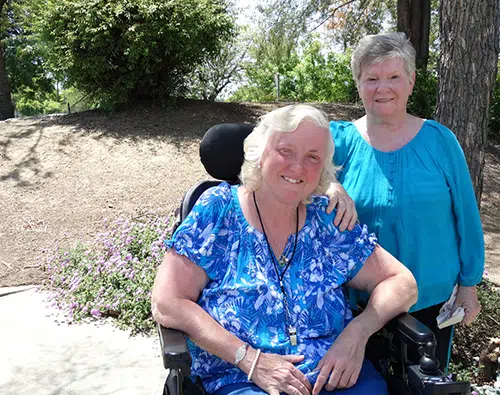
Alice and Gloria
Alice with Gloria, her job coach

“So to me they’re more than just job coaches, they become your friends too,” said Alice.

Ongoing Employment Support from PRIDE

PRIDE Industries has a long history of supporting Alice in her employment at Lighthouse. PRIDE offers many life- and career-related services to people with disabilities and other barriers to employment. These include internships, on the job training and support, independent living services, and job search assistance.

Gloria, Alice’s job coach, has visited her for years. On a weekly basis, they talk about and solve any challenges she might be facing at work.

“Gloria is my sounding board,” explained Alice. “If there was a really big problem and I didn’t feel comfortable going alone to my employer saying this is what I need or this is what I would like, then I know I could call Gloria up and she’d step in and help me talk to them.”

PRIDE’s job coaches provide one-on-one support to help people like Alice find confidence in the workplace. They listen to employees’ struggles and successes while providing advice on how to deal with conflicts, approach a manager, make certain tasks more accessible, and other issues. 

Inspiring Others to Find Meaningful Employment

Alice beautifully exemplifies PRIDE’s vision for each individual. She desires to give back to the community and fulfill a need for purpose in her life. 


“I’ve always known that people are always going to have to help me, regardless of how old I am. My biggest goal in life was to really just work because I wanted to give back to society like they gave to me,” she said.


And Ms. Alice has proven herself to be a very valuable asset inspiring others in her community. She proudly related a story about a young girl she cared for during her first few years at Lighthouse, who told Ms. Alice that she wanted to grow up and be a doctor so she could help Ms. Alice and others like her. All these years later, this now young woman carries with her the precious memories of her childhood inspiration as she currently studies at San Francisco State to become a medical doctor.

PRIDE Industries' services

PRIDE provides services, from pre-employment preparation to ongoing support on the job. We will walk with you every step of your journey, helping you overcome employment barriers and ensuring you find the career path you desire.

Charlie’s day begins at three o’clock in the morning, a time when most of us are still asleep. While the moon is still shining, Charlie prepares to make a two-mile walk to catch the first light rail train. He then catches a bus which connects him to a PRIDE Industries shuttle. After a four hour journey, Charlie is finally delivered to work by seven in the morning. These are the lengths that Charlie goes through, twice a day, because he loves his job.


Charles “Charlie” Curtner, 65, has been working in the PRIDE Industries cafeteria since 2001. He is a vital member of the cafeteria team. His job requires him to clean tables, restock refrigerated beverages and food items, greet customers, and be a backup cashier when needed. Charlie’s work ethic, attention to detail, love for people, and his sense of humor have helped him be successful on the job.


Charlie’s brother introduced him to PRIDE in 1993. He applied for a dishwasher position at a PRIDE military base contract. “You’re hired!” Charlie recalls excitedly. This was only the starting point for Charlie.


Before PRIDE, Charlie had worked for years as a dishwasher in the community. Once at PRIDE, he held a variety of packaging, assembly, and order fulfillment jobs. Still, Charlie wanted more for himself. With support, Charlie found his place with PRIDE’s cafeteria team.


“Charlie is a very friendly person that always greets people and welcomes them to the cafeteria with a warm smile,” says Olivia Jones, Charlie’s supervisor. “He is very dedicated, hardworking, and is always willing to take the extra step to make sure he is doing his job well.”


Charlie has a disability but prefers to focus on his abilities. He lives independently and has for most of his adult life. Charlie does share his home with his cat named Sam, who was abandoned as a kitten, and named after Yosemite Sam, the cartoon character. And while Charlie loves cartoons, if you ask about retirement his response is: “Uh-uh, stay home and watch the idiot box and those goofy shows, oh no way! Wouldn’t that be boring?”


Charlie is very dedicated to his work, a place where his abilities are recognized. At PRIDE he has made friends and can be himself. He finds purpose in his job and often asks his supervisor: “What would you do without me?” Olivia’s response is, “I am not sure, but we do not want to find out.”


Never shy to share his life or funny side, Charlie often begins a conversation with, “Can you believe it?” He then proudly follows up with, “People want to know my secret,” as to how he remains youthful and in excellent health. We still do not know his secret.


While Charlie is no spring chicken, as the saying goes, he does not let age slow him down. Although his secret has not been revealed, he may have given us a clue: keep moving. Charlie’s drive comes from working. “Just keep working,” he says. “Who wants to retire? I have been here 23 years.”


Thank you, Charlie, for your dedication to PRIDE Industries and the cafeteria. We are so glad you are part of the PRIDE family.

Need employment placement support?

Contact our I AM ABLE Helpline to discuss your options.

“Just keep working. Who wants to retire? I have been here 23 years.”

Disability does not discriminate; it can affect anyone at any time through illness or injury. Hilary Vail, a PRIDE Industries job coach, was left with a permanent physical disability due to an injury. Overcoming initial, everyday challenges was just the beginning of her life with disability.


Hilary’s life changed in the blink of an eye after taking a fall. Soon after, she was laid off from her job with a local nonprofit. “My life completely changed, and I could not believe it. It was a shock. I did not expect to fall down the stairs.”


As a single mother of two young boys, Caleb (12) and Nate (9), she knew her family was counting on her. Hilary sought vocational and physical rehabilitation to help her overcome the new challenges. While working with the California Department of Rehabilitation (DOR), she decided to go back to school. Hilary enrolled in a health care training program to become a certified billing and coding specialist.


“As a single mom, I needed to provide for my kids,” says Hilary. “I needed to find something with stability and room to advance.” It was easier said than done. After graduation, Hilary found it nearly impossible to land a job in the field without a minimum of six months of hands-on experience. Hilary was devastated. “I kept applying; I even offered to volunteer – and nothing.”


In May 2014, Hilary began working with PRIDE Industries’ Employment Services including attending Job Club meetings. Job Club provides an opportunity for individuals to gain hands-on interviewing and job-seeking practice. Participants learn new skills and receive help in conducting a job search, along with other employment-related training. Hilary was also assigned a PRIDE job developer and job coach to help her in the search.


“After months and months of doing a job search and working with Debbie Tomlinson, a PRIDE job developer, and Brian Edwards, a PRIDE job coach, I began to get discouraged,” says Hilary.


Hilary has significant mobility and physical restrictions due to her disability. There is no surgical cure. Currently, treatment consists of painful cortisone shots and ongoing physical therapy.


Despite her physical limitations, Hilary aspires to lead a typical life and provide for her two boys.


In March 2015, an opportunity became available for Hilary at PRIDE: an internship in the Employment Services Department at PRIDE headquarters.


PRIDE Industries’ Employment Services Internship Program helps individuals with disabilities enter, or re-enter, the workforce. The Program offers up to 250 hours of paid work experience supported by generous donations and grants to PRIDE Industries Foundation. Through the internship, individuals gain resume-building experience while working in a supportive environment.


Hilary excelled in the internship; it was a perfect fit for her skills. Halfway through the Program; a permanent job coach position was offered. Hilary was ecstatic. Finally, this was the opportunity she needed. “I learned so many new skills,” says Hilary. “Meeting new and wonderful people; I could not be happier.”

She became a PRIDE Industries employee in April 2015. “Hilary has learned the skills of job coaching and assessments,” says Debbie. “Hilary is supporting our clients with employment preparation services – just as she did.”


As a job coach, Hilary works with community clients on her caseload. She provides employment support services and helps people with disabilities improve their skills on the job. Some of the individuals she supports were in Job Club with her. She finds that having an established relationship is an advantage in assisting them, however, for Hilary it feels natural. “I love being able to help,” says Hilary. “That is something that was in me all along, and I like it.” Currently, Hilary has six individuals on her caseload.


Hilary no longer relies on others for financial help. “My kids and I were able to get our own place. I get excited paying my rent,” says Hilary. “To me, it means freedom. I can do it all on my own.”


Stories like Hilary’s remind us that life can change in the blink of an eye. Importantly, we are reminded that we have the power to control our own destiny when provided with support and opportunity. We’re glad that Hilary found her place at PRIDE.

Need employment placement support?

Contact our I AM ABLE Helpline to discuss your options.

“I love being able to help. That is something that was in me all along, and I like it.”

Let’s Talk: Disability Language

October is National Disability Employment Awareness Month (NDEAM). We take this opportunity to highlight the many contributions of America’s workers with disabilities and promote a culture of inclusiveness.


One out of five people in America has a disability, making them our nation’s largest “minority.” The group represents all ages, genders, ethnicities, and socioeconomic levels. The likelihood of joining this group is high. Disability can be acquired at birth, in the blink of an eye due to an accident or injury, or acquired from illness or age.


Despite its frequency, many people are still uncomfortable talking about disability. This uncomfortableness contributes to the obstacles that people with disabilities face in obtaining employment or fully integrating with their workforce. The truth is that there are as many preferences about ways to identify a person with a disability as there are individuals. So what is a well-intentioned person to do? When in doubt: ask. We’ll get to that in a minute, but first, let’s talk about two distinct (and oft-debated) approaches to disability language.

Person-First Language (PFL)

People-first language is generally at the heart of our organization’s disability awareness training. The emphasis is on the person – not the disability or condition. Those who support people-first language (PFL) believe that using a diagnosis or condition as a defining characteristic robs the person of the opportunity to define him or herself. PFL was developed to address the stigma often associated with disability. Advocates wanted to reaffirm that disability does not, in fact, lessen one’s personhood. As such, the PFL movement encourages the use of phrases like “person with a disability,” or “person with autism” instead of “disabled person” or “autistic person.”


The disability community is not only large; it is often divided. Increasingly, a second preference is being voiced: Identity-First Language (IFL).

Identity-First Language (IFL)

For those who prefer identity-first language, “disabled person” is a perfectly acceptable way to identify a person. Their belief is that PFL purposefully separates a person from their disability, presuming that disability is something a person should dissociate from to be considered a whole person.


From their perspective, it also implies that “disability” or “disabled” are negative, derogatory words when, for many, disability is just a part of their being or uniqueness. Within the Autistic community, IFL is preferred by many when Autism is considered as a part of a person’s identity. Using IFL language, you would say that someone is “Autistic,” not a “person with autism.” However, even people with IFL preferences draw an important distinction when it comes to the use of a term strictly for its medical definition. You would never refer to a person based on a diagnosis such as “Down syndrome person” or “cerebral palsy person.”


Confused? You are not alone. So what’s a person to do?

JUST ASK.

The debate between PFL and IFL is proof that words do matter. Language, however, is never “one-size-fits-all.” When in doubt, do not assume. Ask the person how they choose to identify.


Words and language are powerful tools. Language, and the meanings we attach to words, have the power to influence, develop, and change attitudes and beliefs. Each person’s use of language and identity are deeply personal. Just ask and respect their choice.


Quick note: Always avoid terms that dis-empower people or have negative meanings like “handicapped,” “wheelchair-bound,” “crippled,” etc. And please, never use the “R” word. The word “retarded” is a highly offensive term for people with intellectual disabilities.

For more information about People-First and Identity-First Language, here are two more:


Why Person-First Language Doesn’t Always Put the Person First

Identity-First Language

Did You Know?

One out of five people in America has a disability, making them our nation’s largest “minority.”

Ramon’s story in filled with survival and perseverance. As the result of a long battle with cancer, Ramon developed blindness in one eye, which hindered his ability to find work. His journey brought him to PRIDE Industries, which offers individualized support, guidance, and resources to people with disabilities looking for a meaningful job and brighter future.

Employment Barriers for People with Disabilities

At the young age of ten, doctors diagnosed Ramon with a brain tumor. After multiple surgeries, radiation, and chemotherapy treatments, the tumor subsided. Although Raymond had won his battle against cancer, he spent much of his teen years in Mexican hospitals. The cancer also took away most of his sight in his right eye. “My left eye is okay, but the right one, I cannot see with it,” Ramon said. “With my right eye I see darkness.”


Seeking a new beginning and better life, his family relocated to the U.S. in 2001. In this country, Ramon faced new challenges: learning a new language, navigating a new city with a disability, and struggling with financial instability. 


“I never worked; I stayed home,” said Ramon. Many people with disabilities who are unsure where to turn to find a job face this common scenario.


Despite many challenges, Ramon began looking for work and got a job at a fast food restaurant making hamburgers. But his triumph was short-lived. Due to lack of accessibility, the restaurant let Ramon go after just three days. His vision made it nearly impossible for him to see the monitor where orders appeared. Understandably, Ramon was devastated.

Ramon began working for PRIDE in the manufacturing department almost immediately

“This company changed my life, and I thank you very much.”

Connecting People with Disabilities to Work Opportunities

Fortunately, Ramon sought assistance at a local vocational services agency that referred him to PRIDE Industries. 


Following a model of social enterprise, PRIDE offers manufacturing, distribution and facilities service solutions to businesses and public agencies while creating meaningful jobs for people with disabilities. With the support of management and trainers, PRIDE empowers people like Ramon to develop professionally, creating a foundation for the rest of their working lives.


Ramon did not have to wait long for a job at PRIDE — he began working in the manufacturing department almost immediately. For two years, Ramon worked on a variety of packaging, assembly, and order fulfillment projects at PRIDE headquarters in Roseville, CA.


During this time, he also attended night school to learn conversational English. Once he felt comfortable with his language skills, he studied for the citizenship test. In 2007, he took the test and passed, becoming a United States citizen.

Still, Ramon wanted more for himself. His seemingly never-ending energy and aptitude for the work led him to pursue other opportunities within PRIDE.

A Promising Future Thanks to Meaningful Work

“Eight years ago, when we began PRIDE’s high-volume shipping line, we were searching for a skilled hand-packager,” said his supervisor, Matthew Weiss. “Ramon was eager to apply his skills to our new service offering.”


With the position came new challenges. “When I first started, I was confused, and I made boxes too big,” he said. But Ramon learned rapidly and surpassed expectations. 


“We discovered his talent for making boxes and making them quickly,” said Weiss. As simple as it sounds, the complex folds can confound many.


Ramon embraced the opportunity. “I got a permanent position in the shipping department,” said Ramon. “It changed my life.” 


He now has financial independence and, most importantly, health insurance to cover his routine medical expenses. “I get paid vacations, too,” he said. Plus, he is saving for his retirement through his 401K account. “I am happy because I am making money, and I have a 401K.”


Ramon has been part of the shipping team for eight years now. His co-workers call him ‘Speedy Gonzales’ because of his rapid box assembly. 


“What makes Ramon so amazing is that he can succeed despite having extensive vision loss,” said Weiss. “We estimate that he makes over 1,000 boxes per day!”


Despite all he has endured and daily challenges he still faces, Ramon is an optimistic individual who focuses on his blessings. He remembers his good fortune when he visits family in Mexico. “In Mexico there are no jobs. In my hometown, many people are poor.” 


“I am happy here,” he said. “In the United States, I have the opportunity to work.” He is also grateful his tumor has not returned and that he was able to find work with PRIDE. 

PRIDE's coaching, training, and placement programs

If you’re struggling to find a job due to a disability or other barrier to employment, get in touch with PRIDE Industries. We provide coaching, training, placement services, and more to start you on your path to success.

Eric McCullough, 50, is a key member of PRIDE Industries’ custodial team ensuring that the Sacramento International Airport Terminal B is spotless.


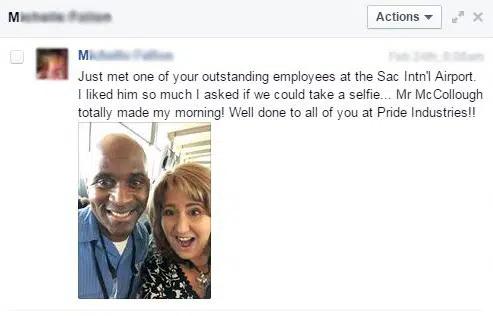
It is hard to miss Eric’s enthusiasm and dedication to his job. He has received numerous letters from travelers praising his work and giving him kudos. In the selfie era, Eric has become an unofficial PRIDE celebrity at the airport. Recently, a traveler posted to PRIDE’s Facebook page: “Just met one of your outstanding employees at the Sacramento International Airport. Liked him so much I asked if we could take a selfie… Mr. McCullough totally made my morning!”

“When doing my job at the airport, I don’t expect people to come up to me and give me recognition. I just let my work speak for itself, says Eric. “I am very serious about that.”


Eric says he is simply doing what he loves. “I enjoy treating the customers with respect; showing them where to go when they get lost, making them feel at home and giving them encouragement.” Although he takes the time to help others and assist where needed, his top priority is accomplishing his tasks. “My main goal is to get my work done in a timely manner.”


Eric has a developmental disability. He was referred to PRIDE at the age of 17,  and he has never wanted to leave the company. Over his 31 years with the company, Eric has held many jobs including a variety of packaging, assembly, and order fulfillment projects. Each job has helped him to develop new skills and improve upon his strengths.


“There are certain things I can’t do as well as other people, but I don’t let that stop me from achieving my goals in life,” says Eric. “I just do the best I can and move on from there.”


Four years ago, Eric decided he was ready for a new challenge. He joined one of PRIDE’s Supported Employment Program groups working at the airport. The Program partners with local businesses to meet their needs while creating community-based jobs for people with disabilities.


Working in the community has been great for Eric. “Eric works full-time, plus all holidays – his attendance is outstanding. He never misses a day,” says Robin Yniguez, a PRIDE Rehabilitation Counselor and Eric’s case manager. “Eric is a very valuable part of the team. He makes us look amazing!”


When asked what motivates him, Eric replies: “The energy in me keeps me going. It keeps me from being bored and gives me an opportunity to do nice things for people that I come in contact with.”


Eric is a humble individual who shares credit for his success. “I am very thankful that God has allowed me to work at the airport and use the talents and the gifts He has given me. If it weren’t for Him, I would not be out there, so I won’t take all the credit. However, I am proud of myself.”


We are proud of Eric, too. We hope his story has inspired you to think about creating opportunities for individuals with disabilities in your business or organization. And, next time you’re traveling through Terminal B in Sacramento, don’t forget to say “hello” to Eric. Better yet, just post your selfie!

Need employment placement support?

Contact our I AM ABLE Helpline to discuss your options.

“I enjoy treating the customers with respect; showing them where to go when they get lost, making them feel at home and giving them encouragement.”