Our Stories

“Do you have access to reliable transportation?”


This seemingly simple question, often asked on a job application or interview, can pose incredible obstacles to a person with a disability. Despite their ability to work and contribute, many individuals with disabilities do not have a driver’s license or access to a vehicle or reliable public transportation, making specific job opportunities inaccessible.


Creating this vital connection to employment, PRIDE Industries provides more than 21,000 rides per month and over 90 routes per day to individuals with disabilities working at PRIDE Industries or with businesses in the community. PRIDE Industries Transit has a fleet of 60 vehicles that cover 52 routes in Placer, Sacramento, Yuba, Nevada, and Sutter Counties in Northern California. PRIDE Industries’ Employment Services also helps individuals navigate public transportation.


Accessible vehicles are not only essential for providing transportation for people with a wide range of disabilities but also senior citizens and those with mobility restrictions. PRIDE’s Transit occasionally helps out in the local community, including for wildfire evacuations.


For more than 13 years, Dan Buchanan has worked as a Bus Driver for PRIDE Industries, transporting employees with disabilities and helping them access opportunities to jobs, paychecks, and independence. He shares his experiences below:

Meet Dan:

“As a Bus Driver, I’m like a captain of a ship. I have the sole responsibility to get employees safely to their destination, starting with the pickup in the morning at their homes and drop-off at work at the Roseville, CA, HQ, or other day programs. Then after a four-hour break, I start the second half of my shift, picking them up and getting them all back home.


When I first got my job at PRIDE, I had zero experience with people with developmental disabilities and felt a little overwhelmed at first. However, it didn’t take long to see how sincere, friendly, and honest the employees that I transport are. Everyone has their own personality traits that you get to learn as time goes on. Most importantly, my passengers love to have fun and tell jokes. My bus has been nicknamed “the party bus.”


As the “captain,” I am also charged with making sure everyone has a pleasant and safe ride, which can be challenging in such a small space with 16 people. To help, I created seating charts on some routes. If the passengers have a respectful attitude, they can sing and make as much noise as they want to!


The best moment of my day is dropping off employees and picking them up at the patio. You get to see so many friendly people that you have transported over the years, and it brightens your day. All of the passengers become very fond of their bus driver, as we spend 2 to 3 hours a day with them. I often receive cards, hand drawn pictures, or a craft item; you can tell that they have spent a lot of time on these objects, and it is very thoughtful.


I have seen how access to transportation makes a difference in people’s lives, as a job gives them meaning and self-respect. When you have been their driver for years, you get to see how employment helps them grow through life. One employee stands out, as I have driven her since the day she started working at PRIDE ten years ago. I have watched her grow into a confident and outgoing person, and I am very proud of her accomplishments and finding a career.”
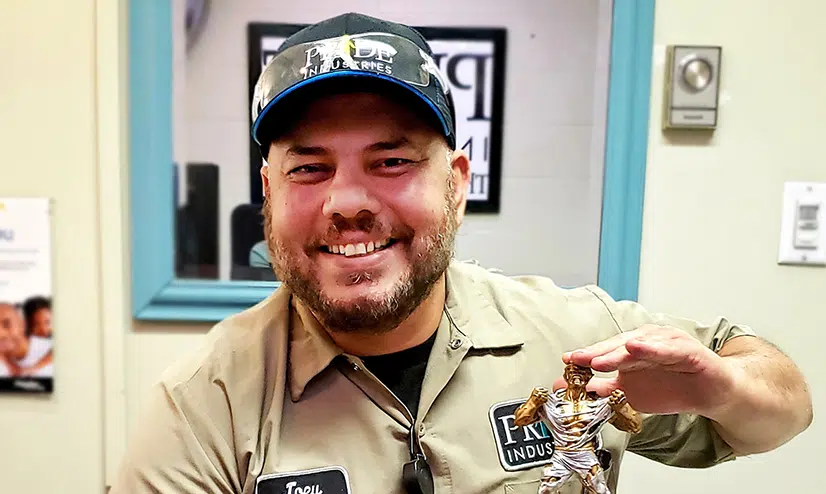
Joey Villarreal is on his way to make history; after finishing his apprenticeship, he will become the first licensed plumber in the state of Texas who is deaf. Working as a General Maintenance Worker for PRIDE Industries for the last eight years, Joey built up his skills while maintaining military and federal buildings.


“Coming to PRIDE was completely different than any other job,” said Joey. ” I had worked at a print shop where I was the only Deaf employee and struggled with communication. My friend John Ferrales, a General Maintenance Worker at PRIDE’s Ft. Bliss, TX location, encouraged me to apply to PRIDE, and I was hired in December 2011.”


The unemployment rate among individuals who are deaf is incredibly high. Fewer than 40 percent of people with a hearing disability work full time, according to the Yang-Tan Institute at Cornell University’s analysis of 2016 American Community Survey data. Despite the misconceptions that deter businesses from hiring deaf and Hard-of-Hearing employees, they can meet and exceed the job requirements, if given the opportunity.


“The General Maintenance Worker position at PRIDE is perfect for me, as I enjoy working with my hands and figuring out creative ways to fix things,” said Joey. “There is no better feeling than when I’m able to solve a problem that no one else can figure out.”


To facilitate communication, Joey uses VRI (a service that offers a sign language interpreter on-demand) to communicate with co-workers and customers, in addition to the on-site PRIDE ASL (American Sign Language) Job Coach and the IMO App to video message (for ASL signing). With these tools, Joey was able to start mastering a trade while expertly serving PRIDE’s customers.


After years of earned expertise working in the plumbing department, Joey felt ready to advance in his career. “Joey has been a great asset,” said Facilities Supervisor Mike McKibbin. “He has an incredible wealth of knowledge that he shares with the rest of the team, he can repair anything from pneumatic pumps, water lines, and general plant utilities.”


While maintaining his current position last summer, Joey started his apprenticeship under Plumber Lewis Ikey. The plumbing apprenticeship requires 8,000 hours of work, and he will become eligible to test for his journeyman license in 2023.


“Joey always does wonderful work and is always willing to take the time to show new employees (including me) around the facility,” said Raina Stevens, PRIDE Job Coach, and ASL Translator. “We appreciate his efforts towards making our facility a better place to work.”


Joey recently represented PRIDE Industries in the community by giving a presentation to high school students about his experience as a Deaf person in the workforce and finding a career in the technical trades field. “It felt important to encourage the students to aim high for their goals and get an education and on-the-job experience.”


Congratulations Joey! We are looking forward to seeing you earn your plumbing license and making your mark in history.

Joey Villarreal

“I have always wanted to help others achieve their goals. Working for PRIDE has given me this opportunity, as I teach and mentor others in the technical trades field.”

Did You Know?

Fewer than 40% of people with a hearing disability work full-time

Transition to civilian life is often complicated and overwhelming. Without the proper support, many veterans find themselves disconnected from the community and services that they need to adjust. In Hawaii, many veterans become homeless as a result of these challenges; they face incredible obstacles to rejoining their communities. PRIDE Industries has partnered with the U.S. Department of Veterans Affairs (VA) to provide employment services, job training, and more to help veterans overcome these barriers.

Going Beyond Employment Services for Veterans in Hawaii

Sean Sullivan was enthusiastic to support people with disabilities and other barriers to employment, including our nation’s veterans. He became an AbilityOne Recruiter and Employment Services Manager with PRIDE Industries in 2015. Since then he has been providing practical assistance to veterans struggling to find jobs and adapt to civilian life. 


But Sean’s efforts did not stop at employment and training services. He connected with Jackie Nguyen, the Community Employment Coordinator (CEC) of the VA Homeless Veterans Employment Services, to explore additional ways they could improve outreach and job placement efforts to address more of the barriers that veterans were facing. 


“When I started as a recruiter, many veterans were referred to my office for placement into PRIDE Industries,” Sean said. “Due to increasing demand, we began to offer services to place people into other jobs and careers in the community, addressing the barriers and obstacles that they faced in getting a job, including housing, transportation, mental and physical health, and transitioning from the military into civilian life.”

Helping Veterans Find Jobs in Their Community

“We both found that many veterans struggle to look for new jobs through USAJOBs or other traditional methods that they are encouraged to use,” said Sean. “Jackie and I strategized on ways to increase the numbers of unemployed veterans placed in employment. Our first course of action was to reach out to employers, like Marriott Hotels, in person, to show how PRIDE Industries and the VA work together to provide employment support for veterans. We emphasize how hiring our nation’s veterans can make a business a true partner in strengthening our communities.”


To help veterans gain job skills, Sean and Jackie began hosting monthly workshops at the Department of Labor and elsewhere. Activities include resume writing, interview role play, team building exercises, and learning how to apply for jobs on USAJOBS. 


“The U.S. Attorney’s Office in Hawaii also participated in the workshops and provided insights and tips to workshop attendees on how to apply for Federal jobs,” said Sean.

Connecting Veterans with Local Employers

In October 2019, PRIDE worked with the Homeless Veterans Employment services to start conducting monthly job fairs. The local Veteran Center and American Job Center were gracious to allow the employment team free use of their space. Promoted locally, the job fair takes place on the first Monday of each month. The local Disability:In Hawaii Chapter and other businesses on Oahu invite employers to interview and offer jobs on the spot.


“So far, since the monthly job fairs started, we have had seven (7) veterans offered jobs on the spot, and an additional nine (9) interviews scheduled in December 2019. We look forward to getting more veterans hired in 2020 and partnering with more businesses to fulfill their staffing need for a qualified workforce,” said Sean.


PRIDE Industries offers a variety of employment services for veterans in Hawaii and across the country. Find out how our vocational training, job placement services, and internship opportunities can help you build a strong career path.

Are you a veteran?

Contact our Veterans Employment Advantage Program for support.

“We emphasize how hiring our nation’s veterans can make a business a true partner in strengthening our communities.”

Most people remember that first job right out of high school. Developing a professional resume, navigating through interview questions, and proving yourself despite a lack of experience, all made reaching that milestone even more special. However, for youth with disabilities, these obstacles are compounded, making that first paycheck even more elusive. This problem hinders further markers of independence, like moving into a new apartment, affording higher education, or purchasing a car. PRIDE Industries offers employment services to help people with disabilities prepare for and secure their first job out of high school and begin the path to their chosen career. 

Partnering with PRIDE Employment Services to Overcome Obstacles

Alexzander turned to PRIDE Industries’ employment services after he graduated high school in 2018. He had minimal experience working in his high school and at a camp for youth in foster care. He was eager for his first permanent job, but after months of searching, he hadn’t found one.


“Whenever I saw a help wanted sign, I would go into the store to fill out an application and introduce myself. While speaking to the manager, I would become incredibly nervous, start stuttering, and completely forget what I wanted to say. Months went by, and I couldn’t find anything. I just wanted a job where I could grow.”


PRIDE Industries’ employment services helped bridge this gap. Alexzander met Carlos Perez, a job developer, via referral, and together they developed a resume and cover letter and practiced interviewing. PRIDE also provided Alexzander with professional work clothes, a planner, and other items to help him succeed.


“I have a learning disability, and Carlos worked with me to develop ways to overcome my anxiety and remember the correct steps while applying and interviewing for a job,” said Alexzander. “The consistent practice made me more confident since I knew that I had support, and Carlos would accompany me to meet with potential employers.”

Employment Services: Laying A Foundation for the Future

All their hard work paid off when Carlos helped connect Alexzander to a paid internship, funded by donations to PRIDE, at a local Rite-Aid store. Eager to start working, Alexzander continually showed up with a positive attitude, impressing his colleagues. “It meant so much when my manager told me that my entire team wanted to invite me to join them as a store associate!”


“I am currently thriving in my job and am starting to learn how to become a cashier and change prices. The best part of each day is making someone’s day a little better.”


Thanks to PRIDE’s donors, Alexzander is now able to build a foundation for his future career. “While learning new skills at my job, I have been saving up money for college; I plan to study computer coding to become a video game or animation designer.

Need employment placement support?

Contact our I AM ABLE Helpline to discuss your options.

“I am currently thriving in my job and am starting to learn how to become a cashier and change prices. The best part of each day is making someone’s day a little better.”

“I grew up in Roosevelt, NJ, a small borough with fewer than 1,000 residents. Several members of my family served in the military, including my Grandfather, who told me stories about World War II in Germany. My Uncle volunteered to serve in Vietnam, and my older brother joined the Air Force, and their stories inspired me to join as well.”


“After graduating from high school, I worked at my Uncle’s diesel mechanics shop for a year. The mechanical skills I learned built a foundation for the rest of my career. I initially tried to enlist in the Air Force, but I have a slight hearing impairment and they declined my application. However, the recruiter for the Navy followed me out of the recruiting center and convinced me to join.”


“After enrolling in 1993, I went to the Naval Station Great Lakes to complete basic training near North Chicago, in Lake County, Illinois. Fortunately, my brother told me everything about transitioning to military life, and I found it a smooth experience. I started as an Apprentice, where you build skills based on basic aviation maintenance and cleaning. It was an enjoyable experience, as I was drawn to engines and the power plant division.”


“After training, I served at Naval Air Facility Atsugi in Japan on the USS Independence. My first time serving abroad was a cultural shock. Slowly, I adjusted to my new lifestyle and enjoyed visiting Okinawa and Iwo Jima.”


“In 1995, I served in Operation Southern Watch, the enforcement of a ban on Iraqi warplanes and helicopters. I worked on the flight deck of the USS Independence, that relieved the USS Kennedy. It was an intense experience, we were constantly on target and had jets ready to fly. We never had to defend ourselves, but the tension was thick 24/7. Serving in that campaign made me proud, but I was relieved to return to Japan.”


“I continued to serve on the USS Independence and was often on the sea for months at a time. Our battle group was forward deployed, meaning that in a moment’s notice, we were prepared to go out to sea. I worked on maintaining the 514 Tomcat Aircrafts (same as the one in Top Gun).”


“I retired from the Navy in 1997 and moved back to New Jersey. Unlike my transition to military life, becoming a civilian was hard. First thing I had to do was find a job. Fortunately, my military experience gave me an advantage, and I found work as a mechanic at a methane power plant.”


“For other veterans struggling to return to civilian life, I would advise them not to be ashamed to ask for help. Talking to other veterans helps with the transition progress, you learn that you are not alone.”


“In 2011, a recruiter contacted me about joining PRIDE Industries at their JB-MDL (Joint Base McGuire-Dix-Lakehurst) Integrated Facilities Management contract. I already had a well-paying job, but PRIDE’s mission of expanding job opportunities for people with disabilities convinced me to join, as this is a cause that’s personally important to me. I was hired as a Small Engine Mechanic and now work as a Small Engine Lead. My coworkers and working on a military base are the best part of my job; they make it all meaningful.”


“Outside of work, I have been a volunteer firefighter and EMT for over ten years with the Roosevelt Volunteer Fire department, which also serves as the town’s police department, traffic control, and public works. We might only get 30 calls a year – but we are always ready. When I first joined, there were only four members. We’ve had ups and downs over the years, but eventually we got up to 18 members.”


“As a military veteran, I am proud to support my country and community.”

“For other veterans struggling to return to civilian life, I would advise them not to be ashamed to ask for help. ”

“Successful mothers are not the ones that have never struggled; they are the ones that never gave up despite their struggles.” Lorena “Lori” Garcia carries this note written by her daughters in her work truck every day. “It’s been faded by the sun over time, but it always brightens my day.”


Lori grew up in El Paso, Texas. Shortly after her high school graduation, she decided to join the U.S. Air Force. Lori served her country as a Supply and Administration clerk in San Antonio, Texas, Little Rock, Arkansas, Biloxi, Mississippi, and Iraq in support of Operation Desert Storm.


“I wanted to fly airplanes so I joined the Air Force in 1992. Transitioning to military life was a drastic lifestyle change. One of my lasting memories involves getting off the bus at Lackland AFB and dropping my bag while in line. It was the loudest sound that I had ever heard, and I was subsequently yelled at. I wondered how I was going to get through this.”


“I had never left home and became incredibly homesick. I kept in mind what my father had always told me; to give everything my best effort. I later became head of my flight squadron and got to lead them in marches, help with GI training, and mentor recruits. I remember an airman who used to cry every night from homesickness, and I helped ease her into military life. She became close with my family and they attended her graduation.”


“Right out of Bootcamp while serving in Mississippi for two weeks in 1993, I volunteered to serve in Iraq during Operation Desert Storm. As part of the C130s supply team, we put parachutes on crates and made sure that troops on the ground were well-supplied. We were far away from friends and family, but we were united in accomplishing our mission.”


“During my military career, I became an Airman First Class and studied to become an informational specialist. I felt incredibly proud to wear the uniform and serve my country. However, before my fourth year while serving in Little Rock, AR, I became pregnant. I asked for a transfer to El Paso to be closer to my family, but they couldn’t accommodate me at the time, so I received an honorable discharge. I moved back and signed up for the inactive reserves. A couple of years later, when I was about to be deployed to Iraq, I discovered that I was pregnant again with my son, and formally left the service.”


“My children are the light of my life; we share a special bond, forged and solidified by overcoming difficult times together. This became especially true when my ex-husband became emotionally abusive. He would tell me that no one else would take us if I left. For a long time, I believed him.”


Lori eventually made the courageous decision to leave her husband to create a better future for herself and her children. Starting over again was not easy, they were left homeless. With true resilience, Lori started her own landscaping business.


“In the early days, we would sleep in our car in parking lots that I was hired to restripe at night while they were empty. When landscaping jobs were slow, I worked as a Bounty Hunter to help supplement my income. I eventually earned enough money to move us into an apartment. I felt incredibly proud to develop this independent life, all on my own.”


The years of hard work began to take their toll on Lori’s health. “I started having back pain while in the Air Force and while landscaping, but I needed to work through the pain to provide for my kids. Eventually, I realized that I needed to quit. Fortunately, I met a person who worked for PRIDE Industries, and they told me about their mission to create opportunities for people with disabilities and veterans. I was impressed and joined PRIDE Industries in 2016 as a Maintenance Trades Helper.”


“From the start, PRIDE Industries was incredibly supportive. I had prior carpentry experience but was given a lot of hands-on training and support.” Through Lori’s hard work, she was promoted to a General Maintenance Worker within her first 90-days of employment. “My goal is to be promoted to Carpenter before 2020, and I am working with my supervisor to check off the needed skills to be ready to apply when a position becomes available.”


To avoid making her back injuries worse, Lori is paired with another employee who can assist her in performing heavy lifting. PRIDE’s Vocational Rehabilitation team of counselors and job coaches are also available for assistance.


“Working in the carpentry field is often challenging, but my job provides meaning and I enjoy the opportunity to continue supporting the military. Civilian life does not have the structure as military life; I feel comfortable and at home at PRIDE. My advice to other veterans would be to not give up when the times are rough and use your training to help with everyday life.”

“My advice to other veterans would be to not give up when the times are rough and use your training to help with everyday life.”