Uncertainties like shifting tariffs, geopolitical changes, and extreme weather have made manufacturers well aware of the need for agile supply chains. But external supply chain management is only part of the logistics equation. Optimizing internal logistics, or intralogistics, is just as important for streamlining operations, improving efficiencies, and reducing costs.
From the receiving dock to the point of picking, packing, and shipping, the systems and processes a company has in place to manage information and material flow can make or break a product line—or even the entire company.
Before advanced technology, a classic intralogistics nightmare was the infamous “lost pallet” scenario. Back when companies had to rely on manual logs and a worker’s fallible memory, pallets could disappear for weeks at a time. And while most businesses could overcome these mishaps decades ago, today’s companies face far more pressures than their predecessors did, including higher consumer expectations, globalization, e-commerce growth, and labor shortages—all of which demand more accurate and technologically advanced internal warehouse operations.
Automation and digital control can take intralogistics to another level, but they work best when layered onto sound processes, rather than used as a shortcut.
Meeting Manufacturing Challenges with Robust Intralogistics
Fortunately for manufacturers, digital technologies such as data analytics and AI are bringing greater precision and power to intralogistics, yielding a host of benefits, including:
- Higher manufacturing line uptime and fewer stoppages caused by missing, late, or incorrect materials.
- Reduced working capital through reduced excess inventory and more accurate stock levels.
- Stronger quality control and compliance via better traceability, status monitoring, and environmental protection.
- Safer, more ergonomic work environments with clearer flows and less manual handling.
- Faster changeovers and greater flexibility to handle product mix, design changes, and demand shifts.
Achieving these benefits requires a deliberate intralogistics strategy, one that treats the internal flow of materials as an integrated system, connected to production planning, quality management, and regulatory requirements. In electronics manufacturing, such a system spans the movement of sensitive components from climate‑controlled storage to kitting and line‑side replenishment into final assembly and test. In medical device production, a comprehensive intralogistics system encompasses cleanroom access, sterile supply handling, and coordination with sterilization and packaging operations.
In both types of manufacturing, the goal is to ensure that materials are always in the right place, at the right time, in the right condition, and with the right documentation, so production can proceed smoothly and compliantly. The following seven best practices provide concrete actions to achieve these goals.
Synchronize Material Flow with Production
A core best practice is to keep material movements in step with the production plan rather than letting logistics and production run on separate tracks. Enterprise resource planning (ERP) systems set the overall plan, while manufacturing execution systems (MES) coordinate what is being built on the shop floor at any given moment. When intralogistics is linked to these systems, material tasks are triggered by actual demand instead of static schedules or ad‑hoc requests.
In an electronics plant, a new build released in the MES can generate a precise list of components and timing for a specific line and shift. Logistics teams then work from clear tasks—preparing and staging kits at defined buffer locations just ahead of changeovers—rather than generic pick lists that may or may not match what the line really needs. If component usage deviates from plan, the system can trigger a top‑up rather than relying on operators to step away and search for parts.
In medical device environments, aligning flow with production often means tying kitting and material release to cleanroom schedules and sterilization cycles, so that materials arrive at controlled areas on time without sitting idle or drifting outside approved conditions.
Minimize Line side and WIP Inventory
Another key practice is to strategically manage line‑side and work in progress (WIP) inventory, instead of letting it accumulate wherever there is space. Excess material at the line can hide problems, increase the risk of using the wrong or expired items, and make the floor harder to navigate. Well‑designed inventory buffers, on the other hand, make the process easier to see and control.
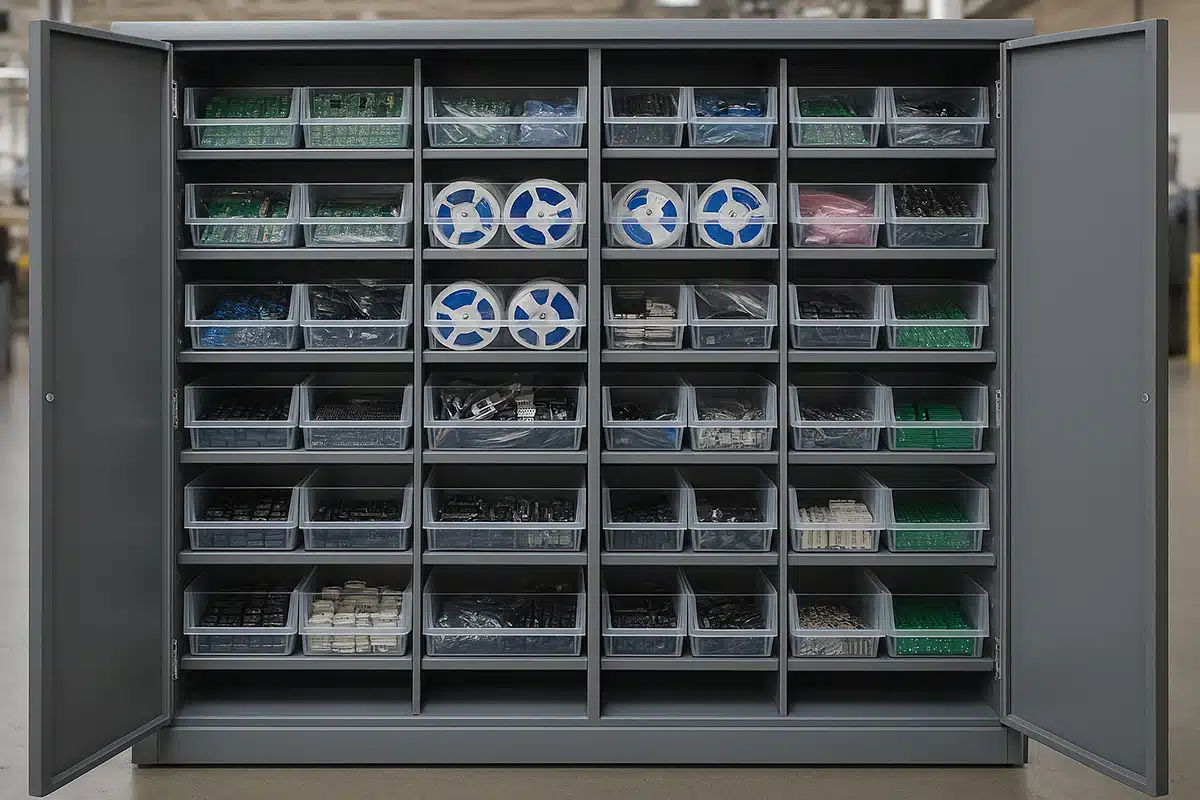
Savvy electronics manufacturers use small internal “supermarkets” between the warehouse and production lines to achieve this inventory balance. These intermediate zones hold limited quantities of each component, usually sized to cover only a few hours of demand. When stock in a location drops below a defined level, a simple signal triggers replenishment of that specific item, keeping material flowing without flooding the line with excess parts.
In medical device production, similar buffer areas between assembly or test stages can be capped with clear capacity limits and first‑in, first‑out rules. This approach surfaces bottlenecks, cuts overproduction, and keeps the number of open lots on the move to a manageable level.
Enforce Traceability and Status Control
For electronics used in critical applications and for medical devices, traceability and material status control are fundamental rather than optional extras. Quality system regulations such as 21 CFR 820 and standards like ISO 13485 require manufacturers to know which materials went into each product and to maintain firm control over material disposition. Robust intralogistics makes that control easy.
Another best practice is to maintain a status‑driven warehouse, where every lot and location carries a defined quality status—such as quarantine, released, on hold, or rejected—and digital systems enforce which statuses can be picked for production. Newly received material goes to quarantine by default, only becoming eligible for normal storage and kitting after the inspection or release steps are complete. If a supplier issue or stability concern appears later, affected lots can be quickly identified, blocked, and physically moved to hold areas.
In electronics destined for safety‑critical or regulated end uses, traceability should extend to the component lot or serial level. Each time components are kitted or assembled, identifiers can be scanned and tied into the device record, building a reliable genealogy. This combination of status control and detailed tracking supports faster, more targeted investigations and reinforces trust with customers and regulators.

Design Flows for Product Integrity
Another hallmark of good intralogistics is designing flows that actively protect product integrity, especially in the face of contamination risk for medical devices and electrostatic discharge (ESD) risk for electronics. These issues often do not show up immediately, but they can have serious consequences down the line if not handled correctly.
In electronics manufacturing, end‑to‑end ESD control is an essential best practice. Store sensitive components in ESD‑safe packaging in controlled areas with suitable flooring, grounding, and handling equipment. Components should also stay in protective containers during transport, whether moved by cart or by an automated vehicle. Workstations and operators should maintain ESD protection all the way through assembly, so that there is no uncontrolled step in the journey.
In medical device manufacturing, a similar best practice applies to contamination and sterility. Material routes should be planned around cleanrooms, controlled storage, and sterilization processes, with goods passing through defined airlocks into clean areas, in sealed containers that are opened only once and only inside the appropriate zone. Paths inside the controlled environment should be laid out to minimize cross‑traffic between cleaner and less‑clean areas, and procedures should spell out how long materials may remain outside controlled conditions and what to do if those limits are exceeded.
When companies build these processes into their intralogistics from the start, the result is fewer surprises during audits and fewer hidden quality risks.
Standardize and Simplify Intralogistics Work
Standardization is another way to lift intralogistics from an ad‑hoc activity to a managed system. When each shift or area handles materials differently, performance varies, training takes longer, and errors are harder to prevent. Lean methods and workplace organization techniques like 5S (Sort, Set in order, Shine, Standardize, Sustain) fix this issue by creating stable, repeatable ways of working.
In a medical device warehouse, standard work can define how materials are received, labeled, inspected, and stored, so they consistently land in the right category of location—quarantine, released, temperature‑controlled, and so on. Kitting areas can use common layouts so that parts always appear in the same positions, with clear documentation and visual cues to support quick checks.
In electronics plants, it’s important to bring this same type of discipline to line‑side areas. Storage positions should be labeled, obsolete items removed, and there should be a defined space for empty containers and nonconforming materials. These practices make departures from the norm easier to spot and simplify employee onboarding. They also support continuous improvement by enabling workers to focus on refining a shared baseline rather than on reconciling different local habits.
Apply Automation and Digital Tools Selectively
Automation and digital control can take intralogistics to another level, but they work best when layered onto sound processes, rather than used as a shortcut. The main aim is to remove friction from routine handling, improve accuracy, and give better visibility into where materials are and how they move.
In electronics environments, automated storage and retrieval systems or vertical lift modules can be used to handle high‑mix component inventories. These systems optimize storage, keep conditions consistent, and—when linked to warehouse and production software—can present required parts to operators in the right sequence for kitting or replenishment. That means less walking, fewer picking errors, and tighter control over sensitive components.
In medical device plants, autonomous mobile robots (AMRs) increasingly handle moves between warehouses, cleanrooms, inspection areas, and sterilization units. A central control system assigns routes and priorities, reacting to changes in material status or production plans. When a lot is released, robots can automatically move it from quarantine to released storage; when a lot goes on hold, tasks can be stopped or redirected to bring material back to a hold area. Used in this way, automation supports stable flow, frees people from repetitive transport work, and generates data that can be used to spot bottlenecks or reliability issues.
Build Quality and Regulatory Readiness into Flows
Well‑designed intralogistics does not defer quality and regulatory needs to the end of the production process; it weaves them into the design of every flow. This is essential in medical device manufacturing and increasingly common in electronics, especially where products serve safety‑critical or highly regulated markets.
When new layouts or logistics processes are planned, cross‑functional teams can review them with an eye to where segregation of nonconforming materials is needed, how expiry and environmental controls will be handled, what must be recorded at each handoff, and how digital systems will support documentation and approvals. A new kitting process for sterile disposables, for instance, might include mandatory scanning of lot numbers and expiry dates, automated checks against approved status, and electronic records that flow directly into the quality system.
Day‑to‑day operations can then reinforce this design with training, routine process checks, and clear expectations. This ensures that the people who handle materials understand not only what steps to follow but why actions such as scanning, labeling, and segregation matter for compliance. Internal audits and walk‑throughs can help ensure intralogistics practices stay aligned with regulations and that issues are detected early and corrected before they turn into bigger problems.
Bringing Intralogistics Best Practices Together
Taken together, these intralogistics best practices form a practical framework for electronics and medical device manufacturing. Aligning material flow with production keeps lines supplied without drowning them in stock, while deliberate management of line‑side and WIP inventory makes operations more transparent and controllable. Strong traceability and status control, combined with flows designed for contamination and ESD protection, preserve product integrity and regulatory compliance.
Standardized logistics work provides a stable base for performance, safety, and continuous improvement, and well‑chosen automation and digital tools extend that base by reducing handling effort and improving visibility. Underneath it all is a mindset that treats quality and regulatory readiness as part of intralogistics design, not external constraints to be worked around. In an industry landscape defined by increasing complexity and tighter expectations, intralogistics managed in this way becomes a quiet but powerful driver of throughput, cost control, and trust.